


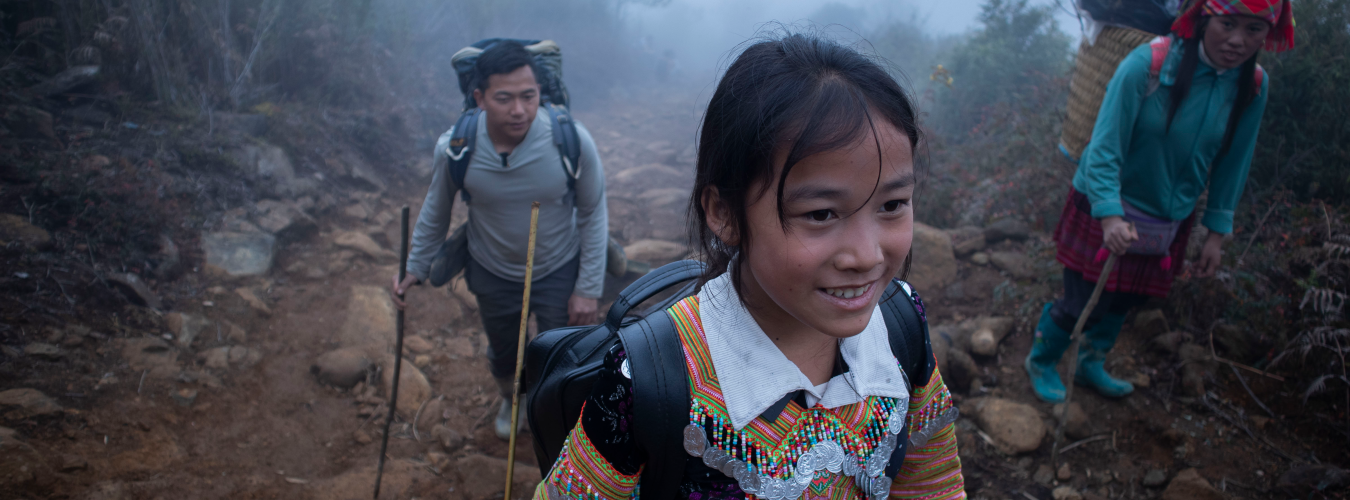
The World Day against Child Labour is widely supported by these actors, along with UN agencies and individuals committed to building a world free of child labour.
Photo:© ILO
Still Waiting for the Final Whistle
The world has halved child labour since 2000. Ending it entirely will require something that has so far been in short supply: political will
There is a certain irony in the timing. As billions of people settle in to watch the 2026 World Cup, cheering young athletes who have had every advantage that training, nutrition and institutional investment can provide, 138 million children around the world are at work. Not at play, not at school, but at work: in fields, in mines, in domestic service, in markets, in the kind of grinding daily labour that forecloses the futures that sport is supposed to symbolise. Nearly 54 million of them are doing work that is hazardous to their health and safety.
The International Labour Organisation has chosen this moment deliberately. The theme of this year’s World Day Against Child Labour, marked on June 12th, is “Red Card to Child Labour: Fair Play for Children, Decent Work for Adults.” The symbolism is not subtle, but it is apt. A tournament watched by virtually every nation on earth is being used to press a point that data alone has failed to drive home: that child labour is not a relic of a pre-industrial past but a present, persistent, large-scale violation of the rights of children whose lives are being shaped, and diminished, right now.
A Record of Progress, a Story of Failure
It would be churlish to deny the progress that has been made. In 2000, the number of children in child labour stood at 246 million. Today it stands at 138 million. That reduction of more than 100 million children over a quarter of a century is a genuine achievement, the product of sustained investment in education, social protection, and legal enforcement across dozens of countries. It demonstrates, as forcefully as any piece of evidence could, that the problem is tractable. Child labour is not an immovable feature of the human condition. It responds to policy.
But the trajectory has bent in the wrong direction. The rate of decline has slowed sharply, the world has already missed its 2025 target for elimination, and according to the ILO and UNICEF, progress would now need to accelerate eleven times faster than its current pace to end child labour within the next five years. That is not a marginal shortfall. It is a systemic failure of ambition and of follow-through.
The geography of that failure is not evenly distributed. Sub-Saharan Africa accounts for nearly two-thirds of all children in child labour, approximately 87 million, and the absolute number has barely moved despite a modest fall in prevalence from 24 to 22 per cent. Population growth, protracted armed conflict, extreme poverty, and social protection systems that are chronically underfunded have combined to cancel out gains that would otherwise have registered as progress. In a region where the population of children is itself growing rapidly, holding the prevalence rate steady while the absolute number stagnates is not an achievement. It is a treadmill.
Asia and the Pacific offer a more encouraging picture, with the child labour rate halving from 6 to 3 per cent since 2020 and the total number falling from 49 million to 28 million. In Latin America and the Caribbean, the prevalence rate held steady but the absolute number fell modestly, from 8 million to around 7 million. These regional variations matter because they point toward the conditions under which progress is possible: sustained economic growth, functioning state institutions, investment in rural education and the political prioritisation of child welfare over short-term labour supply.
The Fields of Exploitation
By sector, agriculture is where the problem is most concentrated and, not coincidentally, where it is hardest to address. Sixty-one per cent of all child labour takes place in farming, fishing, forestry and livestock herding. Services account for 27 per cent and industry, including mining and manufacturing, for 13 per cent. The dominance of agriculture is not accidental. Rural households are where poverty is deepest, where social protection is weakest, where schools are furthest away and least well-resourced, and where labour laws are most difficult to enforce. Children working on family farms, or hired out to commercial agricultural operations, are largely invisible to the inspectors and monitors who police urban factories.
This invisibility has commercial consequences that reach far beyond the villages where child labourers work. The supply chains of the world’s largest food and consumer goods companies pass through precisely these agricultural systems. Cocoa from West Africa, cotton from Central Asia, tobacco from parts of Latin America, seafood from South-East Asia: all have been linked to child labour at various points in the chain of production that ends on supermarket shelves in London, New York and Tokyo. The ILO’s decision to frame this year’s campaign around a sporting event hosted by the United States, Canada and Mexico, three countries whose import-dependent economies are deeply entangled with agricultural supply chains in which child labour persists, is a pointed reminder that consumption in wealthy countries is not innocent of the conditions under which the goods consumed are produced.
Why Children Work
The most important thing to understand about child labour is that it is almost never the result of parental indifference or cultural acceptance. It is almost always the result of economic necessity. When parents cannot earn enough to feed their families, when there is no school within walking distance or no school at all, when illness or disability or bereavement has disrupted household income, children go to work. They go to work because the alternative is hunger. They go to work because the household cannot absorb the loss of their labour. They go to work because, in the absence of any social safety net, their income is what stands between the family and destitution.
This is why the Marrakech Global Framework for Action, adopted at the 6th Global Conference on the Elimination of Child Labour and serving as the ILO’s current roadmap, places such emphasis on decent work for adults. Ending child labour cannot be achieved by targeting children alone. It requires ensuring that the adults in households where children work can earn enough to make the withdrawal of child labour economically survivable. Where parents cannot earn a living wage, exhortations to keep children in school ring hollow.
The framework identifies a set of interlocking interventions: universal social protection, including child benefits that provide a floor of income security for the most vulnerable households; access to quality education, particularly in rural and crisis-affected areas where the absence of schools is itself a driver of child labour; the protection of workers’ rights to organise and bargain collectively; stronger legal enforcement; and accountability mechanisms across agricultural supply chains. None of these is new. None of them is technically difficult to implement. All of them require sustained public investment and political commitment.
The Politics of Inaction
That commitment has been intermittent at best. International targets for the elimination of child labour have been set and missed with a regularity that suggests they serve more as expressions of aspiration than as binding obligations. The 2025 target has come and gone. The new ambition is framed around the next five years, but the eleven-fold acceleration in progress that would be required is an enormous ask for a global system that has shown little capacity to sustain the momentum needed.
Part of the problem is structural. Child labour is concentrated in the countries and communities least able to command international attention and financial resources. Sub-Saharan Africa, where the absolute burden is greatest, is also the region where governance capacity is often weakest, where humanitarian emergencies divert resources and where the fiscal constraints on governments are most severe. The countries that import goods produced with child labour are, for the most part, wealthy enough to set and meet their own standards. But they have been slow to apply those standards with rigour to what they buy from abroad.
The withdrawal of development finance and overseas aid by several major donor countries in recent years has compounded these difficulties. Social protection systems in low-income countries depend heavily on external support to function at the scale needed to make a dent in child labour. When that support is cut, the households at the margin, the ones where the decision between school and work is finely balanced, tip in the wrong direction.
An Obligation, Not a Campaign
The ILO is right to insist that ending child labour is a matter of rights, not charity. Every child has a right to education, to safety, to a childhood not consumed by work. That right is not contingent on the wealth of the country in which the child happens to have been born, or on the profitability of the supply chain in which the child’s labour happens to be embedded. It is a universal entitlement, recognised in international law and ratified by virtually every government on earth.
The gap between that recognition and the reality facing 138 million children is a measure of the distance between stated values and actual priorities. The World Cup, for all its commercial excess and geopolitical complications, genuinely does bring the world together in a shared experience of sporting competition. That shared experience has value. The ILO is using it to ask whether the world that celebrates together is also prepared to act together, not in the modest, incremental way that has characterised the past decade, but at the scale and speed that the problem demands.
The answer, so far, has been no. The question is whether this moment of global attention, however briefly held, can shift that calculation. The evidence of the past quarter century suggests it can be done. What has been lacking is not the knowledge of how, but the will to do it.
Sources: International Labour Organisation, World Day Against Child Labour 2026, June 12th, 2026; ILO and UNICEF joint data and policy recommendations on child labour elimination, 2026; Marrakech Global Framework for Action against Child Labour, 6th Global Conference on the Elimination of Child Labour, 2026.
The Collapse of Child Protection in Armed Conflict
Killing and maiming remained the most frequently verified violation category in 2025. Some 6,266 children were killed and a further 7,958 maimed, representing increases of 34% and 10%...

A Perilous Reckoning for the World’s Fight Against AIDS
The toll falls disproportionately on the young. Every week 3,000 adolescent girls and young women in sub–Saharan Africa acquire HIV, a figure that has barely shifted and that the report...
A Tribunal’s Awkward Retirement
The Mechanism’s prosecutor, Serge Brammertz, agreed that some functions could move to the Secretariat but warned that genocide denial and the glorification of war criminals made the...




Our Network
Our Channels

© 2026 Al Jazeera Media Network. All rights reserved.