

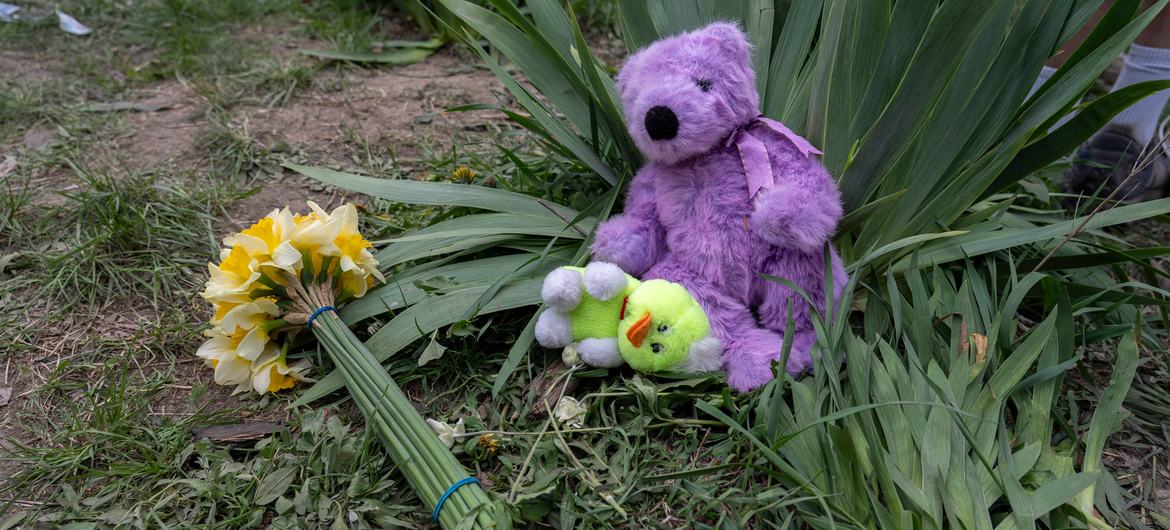
© UNICEF/Oleksii Filippov A bouquet of flowers and soft toys placed near the site of a missile strike, left in memory of the children killed in the early morning attack in Kyiv, Ukraine, on 24 April 2025.
There is a particular kind of moral failure that announces itself through statistics. The numbers contained in the United Nations’ annual report on Children and Armed Conflict, released this week, are of that kind. They do not merely document suffering; they record the systematic unravelling of a global compact that took decades to build and is now being dismantled, conflict by conflict, airstrike by airstrike, abduction by abduction. In 2025, the UN verified 38,558 grave violations affecting 24,174 children. That figure is the highest recorded since the monitoring mandate was established 30 years ago. It is also, in all likelihood, a significant undercount.
The mandate tracks six categories of violation: killing and maiming, recruitment and use of children in hostilities, abduction, rape and other forms of sexual violence, attacks on schools and hospitals, and denial of humanitarian access. In 2025, every single category saw deeply troubling levels of activity. Taken together, they describe not a series of isolated incidents but a pattern of behaviour that has become, in the world’s most active conflict zones, disturbingly normalised. Children are being killed in record numbers, recruited in record numbers, raped in record numbers, and systematically denied the food, medicine and protection that international law obliges warring parties to provide.
The Inversion That Should Alarm Everyone
The most significant finding in this year’s report is not the raw scale of suffering, grave as that is, but a structural shift in who is responsible for it. For the first time since monitoring began, government forces, not non-state armed groups, were the leading perpetrators of grave violations against children. State militaries and government-affiliated forces were responsible for more killings, more maimings, more attacks on schools and hospitals, and more denials of humanitarian access than rebel groups, armed militias or terrorist organisations combined.
This inversion deserves to be understood for what it is. The architecture of child protection in armed conflict was built on a foundational assumption: that states, as bearers of sovereign authority and signatories to international humanitarian law, would ultimately be held to a higher standard than the non-state actors they fought. Governments might fail to restrain their forces; they might look the other way when abuses occurred. But the framework assumed that states were, on balance, the potential solution to the problem of child protection, not its primary source.
That assumption has now been empirically refuted. The five situations generating the highest volumes of violations were the Occupied Palestinian Territory and Israel, the Democratic Republic of the Congo, Nigeria, Myanmar and Somalia. In each of these contexts, state forces and their proxies have been among the principal actors documented as committing or enabling grave violations. The implications are not merely moral. They are structural. When the parties most capable of complying with international law are instead the parties most responsible for violating it, the enforcement mechanisms built around state accountability lose much of their purchase.
The Numbers Behind the Headline
Killing and maiming remained the most frequently verified violation category in 2025. Some 6,266 children were killed and a further 7,958 maimed, representing increases of 34% and 10% respectively on the previous year. These are not small fluctuations at the margins of an otherwise stable picture. They represent a surge. Behind each figure is a child whose life was ended or permanently altered by a decision, taken by an adult with a weapon, to use force in a manner that international law prohibits.
The report is explicit about what is driving these numbers. The increasing use of explosive weapons in densely populated areas, particularly artillery, airstrikes and improvised explosive devices, accounts for a substantial proportion of child casualties. Explosive weapons do not distinguish between combatants and civilians; when deployed in cities, towns and villages, their effects fall disproportionately on those least able to flee or shelter: the elderly, the disabled, and children. The growing integration of artificial intelligence into military targeting processes adds a further layer of concern. AI systems trained on flawed or incomplete data, or optimised for objectives that do not adequately weight civilian harm, can systematise and accelerate violations that human judgment might, at least occasionally, prevent.
Denial of humanitarian access produced 8,322 verified incidents, making it the second most prevalent violation category. Across 12 of the 13 worst hunger hotspots identified by the UN Food and Agriculture Organization and the World Food Programme, conflict is the primary driver of food insecurity. The connection between access denial and child mortality from hunger and preventable disease is not indirect or speculative; it is the intended consequence of a strategy deployed by warring parties who have calculated that starving civilian populations serves their military or political objectives. The deliberate weaponisation of hunger against children is, under the Rome Statute, a war crime. It is being committed at scale.
Some 6,607 children were recruited and used in hostilities in 2025, while 5,129 were abducted, frequently for purposes of recruitment, forced labour or sexual violence. Gang rape, the report notes, is being deployed with growing frequency as a deliberate tactic of war, a form of collective punishment designed to destroy community cohesion, traumatise survivors and signal the total impunity of those who commit it. The 1,667 children detained for actual or alleged association with armed parties represent a category that demands particular attention: these children are, by any credible legal and humanitarian standard, victims first and foremost, and must be treated as such.
The Ecosystem of Impunity
Statistics of this magnitude do not emerge from nowhere. They are the product of an ecosystem in which impunity is structural, accountability is exceptional and the political will to enforce international humanitarian law has been eroding for years.
The UN monitoring and reporting mechanism, established in 1999 and strengthened by subsequent Security Council resolutions, was designed to create pressure through publicity. By naming parties to conflict in annexes to the Secretary-General’s annual report, the mechanism sought to stigmatise violators, trigger diplomatic consequences and incentivise remedial action. In some cases, it has worked. Armed groups and government forces have, on occasion, signed action plans, released child soldiers and undertaken institutional reforms to avoid the reputational and diplomatic costs of being listed. The report notes that around 40 such commitments were made in 2025, including handover protocols and bilateral dialogues in Somalia, Ukraine and Colombia.
But the mechanism’s power is ultimately dependent on the willingness of member states, and particularly the permanent members of the Security Council, to act on its findings. That willingness has been conspicuously absent in the cases that matter most. The Occupied Palestinian Territory and Israel generated the highest volume of violations recorded in any single situation in 2025. The response from the states most capable of applying effective pressure has been, by any candid assessment, inadequate. A similar observation applies to the DRC, where the Rwanda-backed M23 has been engaged in forced recruitment of civilians, including children as young as 12, for military training under conditions that former detainees describe as systematically lethal, while peace agreements are signed and largely ignored.
The pattern is consistent: the more geopolitically significant the conflict, the less likely that the naming and shaming of perpetrators will produce meaningful consequences. This dynamic does not merely fail the children of the most contested conflict zones. It signals to all parties to all conflicts that grave violations against children carry an acceptable level of risk, provided the political context is sufficiently complex or the relevant great powers sufficiently compromised.
Technology as Accelerant
The role of artificial intelligence in targeting decisions merits particular scrutiny. The report notes the growing integration of AI into military processes as a factor driving violations. This is a relatively new dimension of the problem and one whose implications are still being absorbed by the legal and humanitarian communities. AI-assisted targeting systems have been deployed in several of the conflict zones generating the highest child casualty figures. The argument made by their proponents is that they reduce error by processing more data more rapidly than human operators. The argument made by their critics, increasingly supported by evidence, is that they systematise error when the data they are trained on is flawed, when the objectives they are optimised for fail to adequately weight civilian harm, or when the speed of decision-making they enable eliminates the deliberative pause in which proportionality assessments should occur.
The principle of distinction, which requires parties to conflict to distinguish at all times between combatants and civilians, and the principle of proportionality, which prohibits attacks expected to cause civilian harm excessive in relation to the anticipated military advantage, are not aspirational standards. They are binding rules of customary international law applicable to all parties to all armed conflicts. They apply with equal force whether targeting decisions are made by a human commander or an algorithm. The integration of AI into targeting does not create a new legal framework; it creates new opportunities for the systematic violation of existing obligations at a scale and speed that human actors alone could not achieve.
The development of international norms governing autonomous and AI-assisted weapons systems has proceeded with notable slowness relative to the pace of deployment. The Convention on Certain Conventional Weapons has been the principal forum for these discussions, and has produced remarkably little by way of binding constraint. The humanitarian costs of this governance failure are now being documented in the UN’s annual reports on children and armed conflict.
The Economics of Protection
Behind the legal and military dimensions of the crisis lies a resource problem of growing severity. Humanitarian funding for the situations generating the highest volumes of child violations has been declining relative to need for several years. The 2026 Lebanon Flash Appeal stands at only 32.7% funded. Across the 13 worst hunger hotspots identified by FAO and WFP, support for food assistance, emergency farming and nutrition responses fell by an estimated 59% between 2022 and 2025. The reintegration programmes that Ms Frazier rightly describes as essential to rebuilding children’s futures are chronically underfunded, particularly for children with disabilities acquired in conflict.
The economic argument for investing in child protection and reintegration is, in fact, compelling even on purely instrumental grounds, setting aside the moral case entirely. Children who are reintegrated successfully into their communities are less likely to be re-recruited, less likely to perpetuate cycles of violence into adulthood and more likely to contribute productively to post-conflict reconstruction. The cost of failing to invest in reintegration is paid not once but repeatedly, across generations and across the full arc of a child’s life and the lives of those around them.
Some 13,112 children received protection or reintegration support in 2025. That figure should be celebrated for what it represents in individual lives redirected. It should also be read against the backdrop of 24,174 children affected by grave violations in the same year. The gap between need and response is not narrowing.
What Must Change
The 30th anniversary of the Children and Armed Conflict mandate is an occasion for honest assessment rather than institutional self-congratulation. The mandate has produced a body of evidence that is, by any measure, impressive in its scope and rigour. It has created accountability mechanisms that, in some contexts, have produced real improvements. But the trajectory of the data is unmistakable, and no amount of institutional pride should obscure it. The situation for children in armed conflict is getting worse, not better. The record violations of 2025 did not emerge despite the existence of the mandate; they emerged alongside it, in conflicts where the mandates’ findings were well known and largely unacted upon.
Three things are needed with some urgency. First, the Security Council must find ways to ensure that the listing of parties to conflict in the Secretary-General’s annexes carries genuine diplomatic and economic consequences, not merely the reputational discomfort that powerful states have demonstrated they can absorb without significant change in behaviour. This will require member states to engage with the mandate’s findings in good faith rather than treating them as a tool to be wielded selectively against adversaries while deflecting its application to allies.
Second, the development of binding international norms governing AI-assisted targeting must be accelerated. The humanitarian case for doing so is now documented at scale. The political will to act on it remains insufficient. The states most actively deploying these systems bear a particular responsibility to engage constructively in norm-setting processes rather than obstructing them.
Third, the funding gap for child protection, reintegration and humanitarian access must be addressed. This is, ultimately, a question of political priorities. The resources required to close it are not, in the context of global military expenditure, large. The global military budget exceeded $2.4 trillion in 2024. The reintegration and protection needs documented in this report could be substantially addressed for a fraction of a single percentage point of that figure.
None of this is technically difficult. The knowledge of what works exists. The legal framework exists. The monitoring infrastructure exists. What is missing is the political will to treat children in armed conflict as a priority that warrants sustained, serious and adequately resourced action rather than periodic expressions of concern followed by insufficient response.
Vanessa Frazier is right that protecting children is not an aspiration but an obligation. The distance between obligation and practice, measured in the lives of 24,174 children, is the true subject of this report. It is a distance that the international community has the capacity, and the responsibility, to close.
Sources: UN Report on Children and Armed Conflict (CAAC), UN News, 17 June 2026; FAO/WFP Hunger Hotspots Report, 17 June 2026; UNICEF Lebanon Flash Update, 17 June 2026; Human Rights Watch, “Congo: M23 Forced Recruitment,” 18 June 2026; Stockholm International Peace Research Institute (SIPRI), Global Military Expenditure Data, 2024; UN Security Council Resolutions 1261 (1999), 1612 (2005), 1882 (2009), 1998 (2011), 2068 (2012), 2143 (2014), 2225 (2015); Rome Statute of the International Criminal Court, Articles 7 and 8; Convention on Certain Conventional Weapons, Meetings of Experts on Lethal Autonomous Weapons Systems, 2014 to 2026
World Day Against Child Labour: The Day the World Plays While Its Children Work
By sector, agriculture is where the problem is most concentrated and, not coincidentally, where it is hardest to address. Sixty-one per cent of all child labour takes place in farming, fishing,...
Slow Progress: Twenty Years of Disability Rights
Only 28 per cent of people with significant disabilities have access to social protection benefits globally, while on average households with a person with a disability spend 14 per cent more of...
- Most Viewed
- Most Popular

Our Network
Our Channels

© 2026 Al Jazeera Media Network. All rights reserved.