

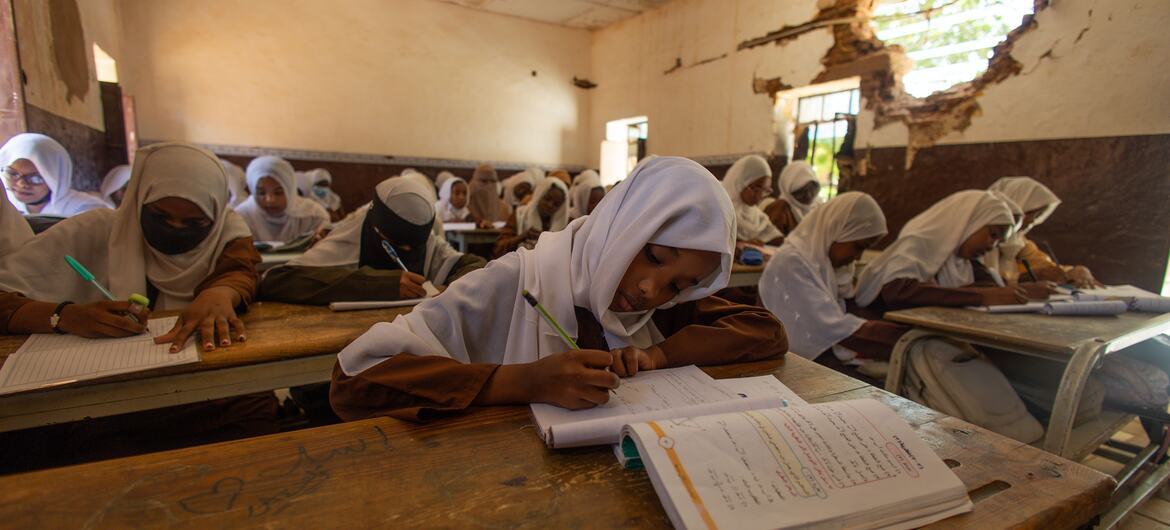
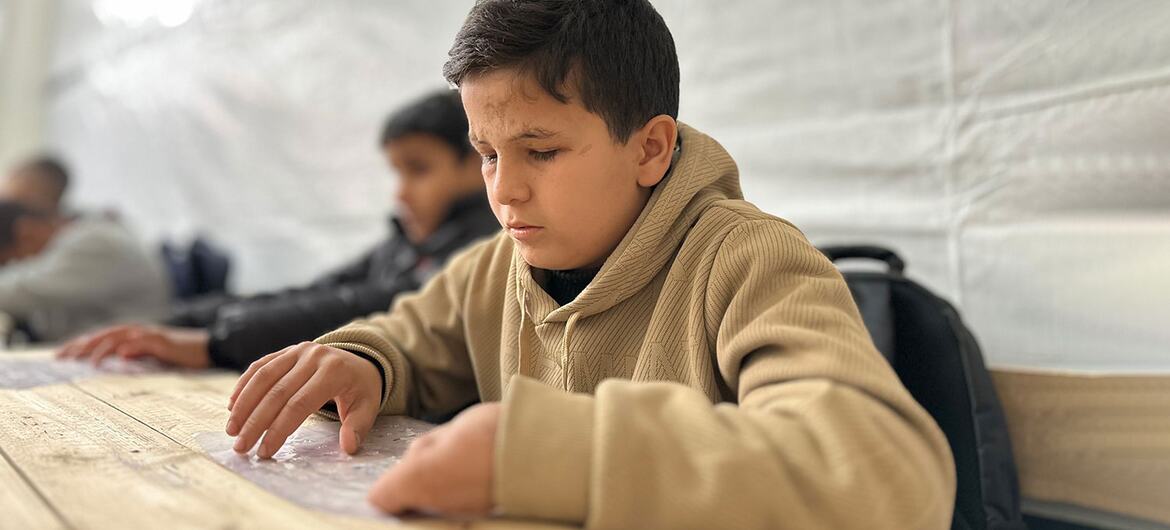
© UNICEF/Ahmed Mohamdeen Elfati Girls study in a partially destroyed classroom in Khartoum State, Sudan
Conflict and climate are shutting 258 million children out of school; the losses may prove permanent
There is a particular cruelty to a school left empty. A building designed to open minds instead becomes a symbol of all that has closed: opportunity, mobility, the quiet possibility of a future different from the present. Across the world’s most broken places, that symbol is multiplying. A major new report from Education Cannot Wait (ECW), the United Nations global fund for education in emergencies, finds that 258 million school-age children and adolescents are now living with disrupted or denied education as a direct consequence of conflict, forced displacement, and climate shocks. Of those, 93 million are not in school at all. The rest are enrolled in a fiction: present on a register, absent from learning.
The scale is staggering. The concentration is worse. Of the 182 million crisis-affected children living across the 20 countries identified as the highest-severity emergency contexts, fully 74 million are out of school entirely. That is nearly four in every five out-of-school crisis-affected children in the world, clustered in a handful of catastrophes, most of them man-made, many of them long-running, and all of them accelerating. Sudan, Gaza, the Democratic Republic of Congo, Myanmar, Somalia: the names are familiar from humanitarian bulletins and Security Council vetoes alike. What is less often acknowledged is the degree to which each of these crises is simultaneously an education emergency of the first order.
The learning gap no headline captures
Enrolment statistics have long served as a convenient proxy for educational health. They are, in crisis settings, a deeply misleading one. ECW’s report, Breaking Barriers: Understanding Educational Exclusion in Crises, is unusual in its insistence on looking beyond the school gate. What it finds behind that gate is troubling. In some conflict-affected contexts, fewer than one in ten children in the early primary grades demonstrate basic reading proficiency. The deficit compounds as children age. By Grade 6, only 30 per cent of children in conflict-affected countries achieve reading proficiency, compared with 47 per cent in countries experiencing primarily socioeconomic crises, and 63 per cent in those affected mainly by natural disasters. The gradient is not accidental. It reflects the particular devastation that armed conflict inflicts on the educational ecosystem: the loss of trained teachers, the destruction of infrastructure, the psychological damage to children who have witnessed violence, and the constant instability that makes sustained instruction nearly impossible.
The distinction matters enormously for policy. Governments and donors have for decades measured educational progress by access: are children in school? The answer in crisis contexts is almost always inadequate. But the subtler and ultimately more consequential question is whether children in school are learning anything. The evidence suggests that in conflict zones, many are not. A child who spends six years in a classroom without acquiring functional literacy has not merely been failed by a crisis; she has been failed by an international response that counted her as a success.
Who bears the heaviest burden
The report is careful to disaggregate its findings, and the results confirm what practitioners have long suspected. Displaced children face a compounding set of disadvantages that distinguishes them even from the already-disadvantaged populations around them. Analysis spanning Burkina Faso, the Central African Republic, the Democratic Republic of Congo, Mali, and Somalia found that displaced children experience systematically lower promotion rates, slower educational progression, and are significantly more likely to be over-age for their grade. The last point deserves emphasis. Over-age enrolment is both a symptom and a predictor: it reflects interrupted schooling in the past and dramatically increases the probability of dropout in the future, particularly as adolescence introduces economic pressures, early marriage, and the competing demands of survival.
Girls face obstacles that require no great elaboration but continue to demand them. In many of the contexts under review, girls’ enrolment drops sharply at secondary level, as families facing impossible trade-offs prioritise sons, and as the physical insecurity of journeys to school falls disproportionately on daughters. The threat of gender-based violence, including sexual violence associated with conflict, has in numerous settings become an explicit instrument for keeping girls away from education. Refugees, who must navigate legal status, language barriers, discrimination, and often the administrative hostility of host-country school systems, face their own distinct set of exclusions. Children living with disabilities, already marginalised in most education systems worldwide, are further marginalised in crisis settings where the already-thin provision of inclusive education dissolves entirely.
A crisis of capacity, not of desire
One of the report’s most important findings is also its most counterintuitive to those who might assume that demand for education collapses in humanitarian emergencies. It does not. The analysis finds that financial barriers and conflict-related school closures account for nearly 80 per cent of school withdrawals. Families are not abandoning education. They are being denied it. The distinction is not semantic. It changes the entire framing of the policy response. Where withdrawal is a product of poverty or proximity to violence rather than of indifference, targeted interventions, cash transfers, safe passage arrangements, temporary learning centres, accelerated education programmes, and community-based instruction can reach families who are actively looking for a door back in.
This resilience is not a reason for complacency. It is a reason for urgency. When families value education but cannot access it, every month of delay is a month of irreversible loss. The cognitive window for foundational learning is not infinitely elastic. A child who does not acquire literacy in the early grades faces a steepening climb thereafter. A generation that loses multiple years to conflict and displacement does not simply resume where it left off when peace returns. The gaps become permanent features of adult life: lower earnings, worse health outcomes, greater vulnerability to recruitment into armed groups, and reduced capacity to participate in whatever reconstruction eventually follows.
Climate’s compounding role
The inclusion of climate shocks in ECW’s analytical framework reflects a relatively recent but increasingly important shift in how humanitarian actors think about education. Historically, climate disasters and conflict were treated as largely separate triggers of educational disruption. The evidence increasingly suggests they interact. Droughts displace pastoral communities, pushing children into contexts with no accessible schooling. Flooding destroys schools and disrupts terms. Cyclones flatten infrastructure and displace teachers. In the Sahel, the Horn of Africa, and parts of South and South-East Asia, climate shocks are not episodic interruptions but recurring features of life, compressing the already-narrow windows in which continuous education is possible.
The report’s comparison of learning outcomes across crisis types is illuminating here. Children in countries affected primarily by natural disasters achieve significantly better reading proficiency by Grade 6 (63 per cent) than those in conflict zones (30 per cent), but still far below global norms. The implication is clear: even climate crises without attendant conflict impose lasting educational damage. As the frequency and intensity of extreme weather events increases under climate change, the population of children facing educational disruption for climate-related reasons will grow even in countries that are spared the additional devastation of armed conflict.
The funding gap that explains the policy gap
Education in emergencies has long been the orphan of humanitarian finance. It typically receives a fraction of the proportional funding allocated to food, shelter, and health in emergency responses, despite substantial evidence that educational continuity serves functions well beyond learning itself. Schools provide protection, nutrition, psychosocial support, and community anchoring. Their closure concentrates children in less supervised settings, increases exposure to recruitment and trafficking, and accelerates family dissolution. The humanitarian case for education funding is as strong as the developmental one.
ECW was established precisely to address this gap, and its operational record is creditable. Since its founding, the fund reports having reached more than 14 million crisis-affected children. It aims to reach a further 10 million by 2030. Maysa Jalbout, the fund’s director, has been forthright in warning that the pace of progress is insufficient to reverse what conflict and climate change are inflicting on educational gains built over decades. She is right to sound that alarm. The numbers are too large and the trends too entrenched to be addressed by project-level interventions, however well-designed.
What is needed is a structural shift: in the priority given to education within humanitarian response architecture, in the willingness of major donors to make long-term commitments to education in contexts that may remain unstable for years or decades, in the readiness of national governments to plan for educational continuity under conditions of chronic insecurity, and in the capacity of international institutions to coordinate across the humanitarian-development divide that currently leaves millions of children stranded between emergency response and systemic reform.
The permanent cost of temporary neglect
There is a temptation, in the face of figures as large as 258 million, to reach for the language of catastrophe and stop there. It is more useful, and more honest, to insist on the arithmetic of inaction. Each year that a child spends out of school in a conflict zone translates, on average, into measurable reductions in lifetime earnings, health, and civic participation. Each cohort of children who pass through a decade of conflict without acquiring foundational skills represents not merely a lost generation but a compounding liability: lower productivity, higher dependence, reduced resilience to the next shock.
The children counted in ECW’s report are not abstractions. They are the daughters of displaced families in Darfur sitting outside schools they cannot enter. They are the sons of refugee parents in camps where the nearest learning centre is too dangerous to reach or too overcrowded to matter. They are the children of the Sahel and the Horn, whose seasons are governed now not by agricultural rhythms but by the irregularity of rainfall and the movements of armed groups. The emergencies that surround them are real. But so is the evidence that, with consistent investment and political will, educational continuity in crisis is achievable.
The losses are not yet fully permanent. That is the only window that remains.
Sources: Education Cannot Wait, Breaking Barriers: Understanding Educational Exclusion in Crises, UN News, 23 June 2026
World Day Against Child Labour: The Day the World Plays While Its Children Work
By sector, agriculture is where the problem is most concentrated and, not coincidentally, where it is hardest to address. Sixty-one per cent of all child labour takes place in farming, fishing,...
Slow Progress: Twenty Years of Disability Rights
Only 28 per cent of people with significant disabilities have access to social protection benefits globally, while on average households with a person with a disability spend 14 per cent more of...
- Most Viewed
- Most Popular



Our Network
Our Channels

© 2026 Al Jazeera Media Network. All rights reserved.