
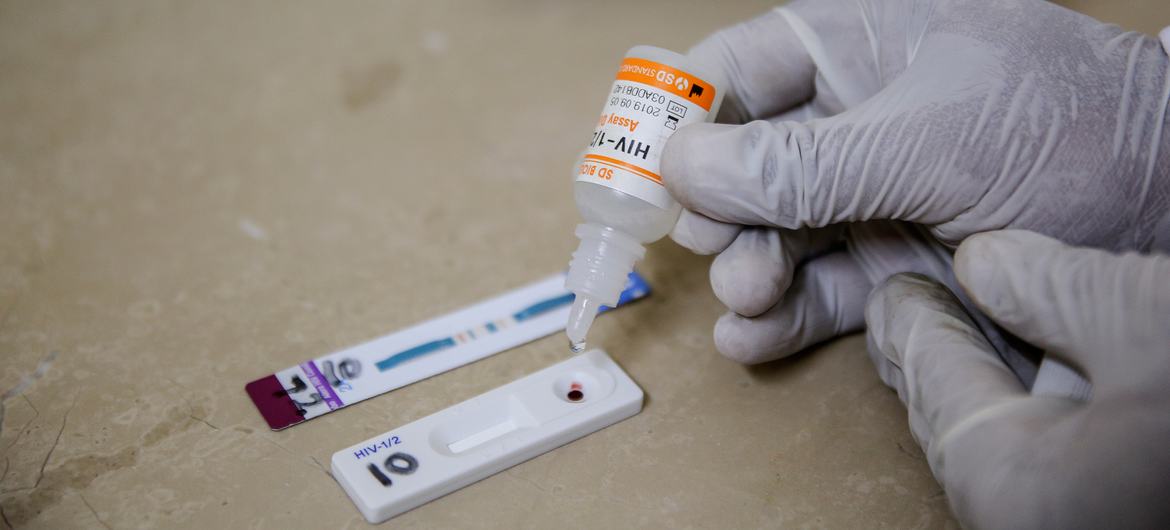
© WHO/Asad Zaidi A lab technician conducts an HIV screening test at a medical centre in Hayatabad in the Peshawar district of Pakistan.
For a quarter of a century the global response to HIV has stood as one of public health’s clearer triumphs. Since 2010 AIDS related deaths have fallen by 56%, from 1.3m to 570,000 in 2025. New infections are down 43%, to 1.2m. Of the 40.9m people living with HIV worldwide, 78%, or 32.1m, are now on treatment. More than 26.9m lives have been saved since the response began. A new report from UNAIDS, published on 12 June, calls this achievement “the most successful story in global health over the last 25 years.” It also delivers a blunt warning: that story is now at greater risk than at any point since it began.
Money draining away
The scale of the financial retreat is striking. Global development assistance for HIV fell by 23% in 2025, the steepest annual drop ever recorded. The consequences are immediate and measurable. HIV testing programmes in high burden countries dropped 22% between 2024 and 2025, meaning fewer people are diagnosed and linked to treatment while the virus continues to circulate. Funding for condoms has been cut by more than 90% in some settings. Uptake of pre-exposure prophylaxis, the daily pill known as PrEP that prevents infection, fell by 38% across the 62 countries that report such data to UNAIDS.
This matters because prevention was already the most neglected part of the response, accounting for just 11% of total HIV spending in 2024. That sliver is now shrinking further, even as long-acting prevention tools such as lenacapavir, an injectable given twice a year, begin reaching patients. By the end of March 2026 just over 6,000 people were receiving it across five sub–Saharan African countries, a fraction of the 20m UNAIDS estimates need such protection.
The retreat is led by the United States but not confined to it. Washington’s reversal of funding through PEPFAR and USAID in early 2025 sent shockwaves through the continent that depends most heavily on it. Several of the highest burden countries are almost entirely reliant on PEPFAR for HIV prevention work: Malawi (88.5%), Zimbabwe (82.7%) and Mozambique (81.8%) among them. The DREAMS programme, which had reached 2m adolescent girls and young women across ten countries, has been shut down entirely. South Africa, which received $453m in PEPFAR funding in 2024 and had been allocated $439m for 2025 before the money was frozen, was later granted a six month “bridge plan” worth $115m running from October 2025 to March 2026, with no clarity on what follows. Modelling published in The Lancet HIV suggests that a sustained disruption to PEPFAR could lead to between 7.5m and 13.4m additional AIDS related deaths by 2030, and a separate analysis projects an extra 1m HIV infection among children in sub Saharan Africa, with around 500,000 deaths and 2m children left orphaned. The retreat has spread beyond America too. Britain, Germany, and other donors have announced cuts to HIV funding for Africa of between 25% and 40% for 2026.
For Western and central Africa, where roughly 90% of HIV treatment programmes depend on external funding, the arithmetic is unforgiving. Nearly 9m people living with HIV are still not on treatment. Without sustained outside financing, and with domestic budgets in many countries already stretched, the report warns plainly of treatment interruptions, and the rising deaths and new infections that would follow.
A rollback of rights
The funding crisis has coincided with, and reinforced, a retreat from the rights-based approach that underpinned the response’s earlier success. For the first time since UNAIDS began tracking the trend, criminalisation of marginalised groups is increasing rather than receding. In 2025 two additional countries introduced laws criminalising same sex sexual activity, and in 2026 a further country increased the penalties for it. Sex work remains criminalised in 168 countries and same sex activity is banned in 64.
The effect on the ground is severe. A study of 79 community led organisations across 47 countries in Asia Pacific, Latin America and Africa found an overall 50% drop in community support services for people living with HIV, an 82% reduction in services for sex workers and an 85% fall in services for men who have sex with men. Support for survivors of gender-based violence is also declining. These organisations are not peripheral. UNAIDS estimates they deliver services to as much as 60% of the key populations they serve, often where government health systems will not or cannot reach. As Winnie Byanyima, UNAIDS’s executive director, puts it, “diseases spread fastest where human rights are weakest.” She describes the rollback as “organised” and “political,” with direct consequences for who tests, who seeks care, and who does not.
The toll falls disproportionately on the young. Every week 3,000 adolescent girls and young women in sub–Saharan Africa acquire HIV, a figure that has barely shifted and that the report singles out as among the clearest signs that the response is failing those who need it most.
Where the light still gets in
The picture is not uniformly bleak. The share of the global HIV response funded by domestic resources has risen from 28% in 2010 to 52% in 2024, and since January 2025 more than 54 countries have pledged to increase domestic financing further. Of 60 countries reporting forecasts for 2026, 25 expect to raise their domestic HIV budgets, a collective increase of around 8%, equivalent to roughly $180m in additional resources. More than 30 countries are now drawing up sustainability roadmaps with UNAIDS support, aimed at building HIV responses that are nationally owned by 2030.
Integration offers another route forward. A quarter of the 152 countries surveyed have folded HIV services into broader health strategies, and more than 80 countries have incorporated cervical cancer screening into their national HIV guidelines, an example of the kind of efficiency UNAIDS argues could cut the annual cost of the global response by around $7bn if pursued at scale.
Yet the obstacles are formidable. Twenty-eight African countries now spend more on servicing debt than on health, a constraint that no amount of programme redesign can fully offset. And progress is geographically uneven. While five countries, Lesotho, Malawi, Nepal, Rwanda and Zimbabwe, achieved a 75% reduction in new infections compared with 2010 by the end of 2024, new infections are rising in eastern Europe and central Asia, the Middle East and north Africa, and Latin America.
The political test ahead
The reckoning arrives at a pointed moment. On 22 and 23 June the United Nations General Assembly convenes a high-level meeting on HIV and AIDS in New York, the last such gathering before the 2030 deadline to end AIDS as a public health threat. Member states are due to adopt a new political declaration built on the Global AIDS Strategy 2026-2031, with headline targets of 40m people on antiretroviral treatment and 20m on preventive medicines by 2030, alongside a commitment that all people receive services free of stigma and discrimination. UNAIDS calculates that meeting these targets could avert a further 3.2m new infections.
In the report’s framing, none of this is a question of scientific capability. The tools exist, including the new generation of long-acting prevention drugs that donors including the Global Fund and the United States have begun procuring at scale. The question, in Ms Byanyima’s words, is “political: will we invest, or will we retreat?” Whether the ambition agreed in New York this week survives contact with shrinking budgets, mounting debt and tightening laws will determine whether the past 25 years of progress against HIV are consolidated, or begin, for the first time, to come undone.
Sources:
UNAIDS, “A ‘perilous moment’ for the response to HIV warns UNAIDS” and accompanying Global AIDS brief, 12 June 2026.
UNAIDS, “UNAIDS calls for renewed global solidarity as UN Secretary General’s report warns that AIDS is not over and fragile gains are at risk,” 4 June 2026.
UNAIDS, 2025 Global AIDS Update, “AIDS, Crisis and the Power to Transform,” July 2025.
UNAIDS, “Impact of US funding cuts on HIV programmes in East and Southern Africa,” 31 March 2025, updated 19 January 2026.
The Lancet HIV, “The impact of cuts in the US President’s Emergency Plan for AIDS Relief funding for HIV pre-exposure prophylaxis in sub Saharan Africa: a modelling study,” October 2025.
CIDRAP, “PEPFAR funding cuts will lead to up to 74,000 excess HIV deaths in Africa by 2030, experts warn,” 2025.
Health Policy Watch, “South Africa May Be Excluded From Future US Grants For HIV Amid Political Row,” 24 November 2025.
The Leaflet, “How US Funding Cuts Created a Double Threat to HIV Progress in Africa,” 15 April 2026.
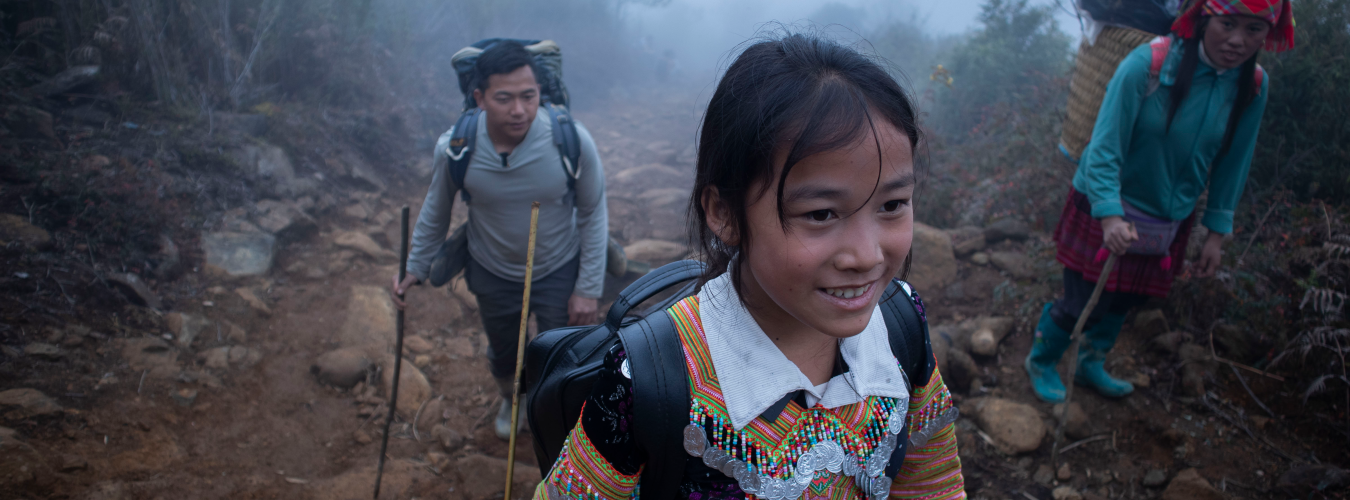
World Day Against Child Labour: The Day the World Plays While Its Children Work
By sector, agriculture is where the problem is most concentrated and, not coincidentally, where it is hardest to address. Sixty-one per cent of all child labour takes place in farming, fishing,...
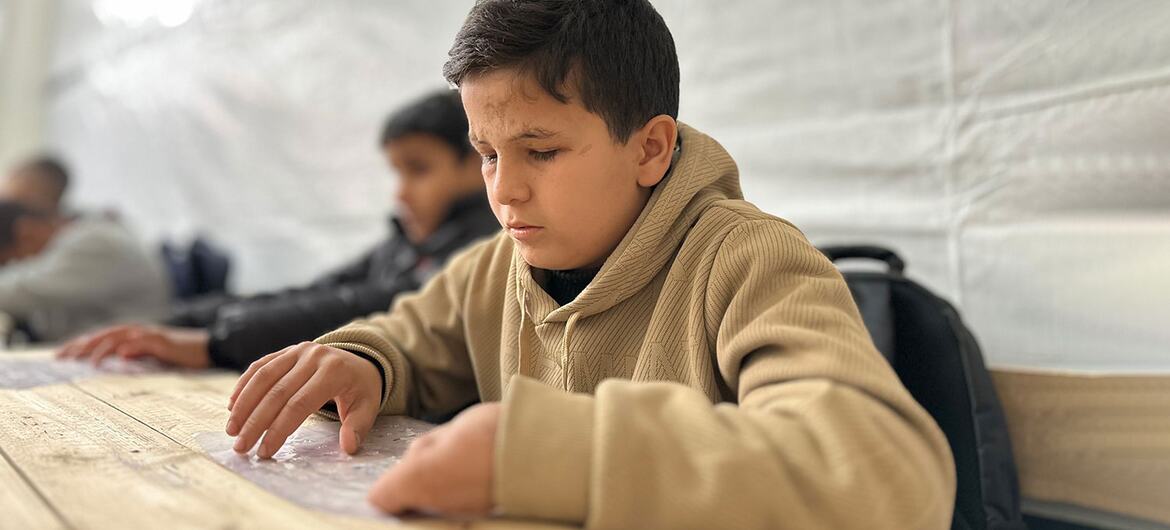
Slow Progress: Twenty Years of Disability Rights
Only 28 per cent of people with significant disabilities have access to social protection benefits globally, while on average households with a person with a disability spend 14 per cent more of...
- Most Viewed
- Most Popular


Our Network
Our Channels

© 2026 Al Jazeera Media Network. All rights reserved.