

The Silencing of the Press
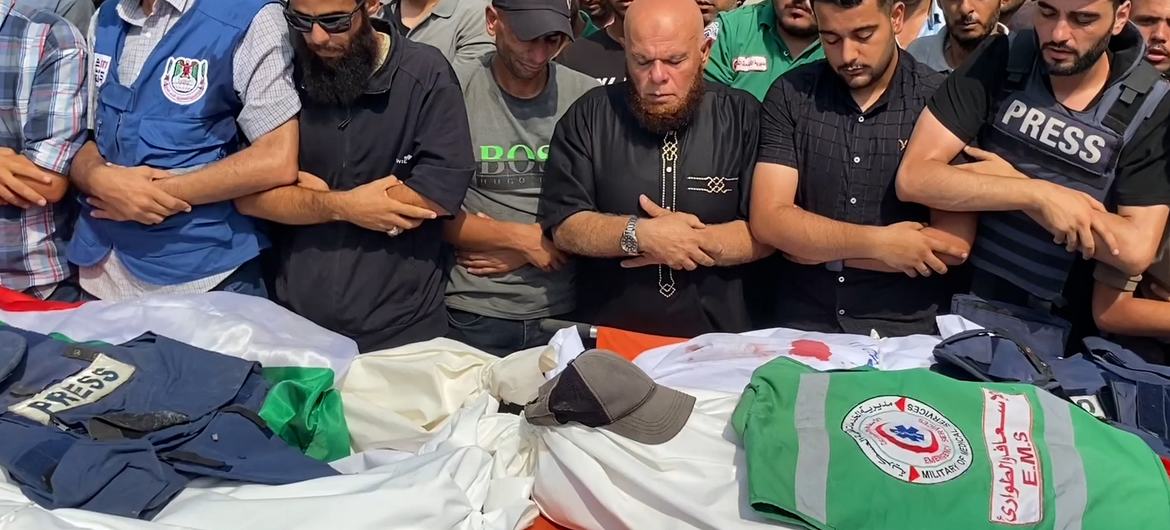
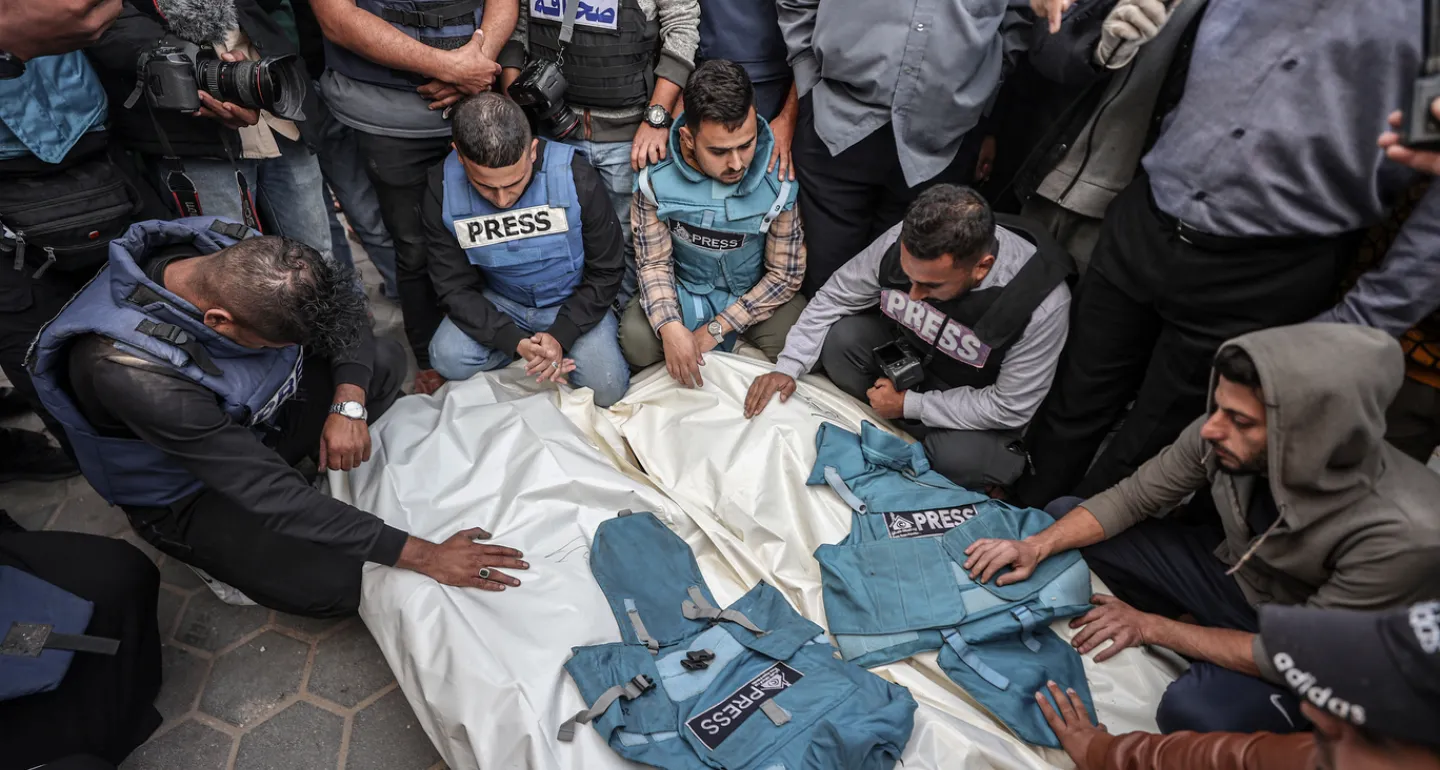
UN News Mourners perform the funeral prayer for Palestinian journalists killed in an Israeli airstrike on 10 August 2025.
Journalism has always carried risk. Reporters have long ventured into uncomfortable places, asked uncomfortable questions, and paid uncomfortable prices for doing so. But the scale and variety of threats now facing media workers around the world represent something qualitatively different from the ordinary hazards of the trade. A profession once described as the first draft of history is increasingly written in conditions that resemble a war zone, because in many cases it literally is one.
A Profession Under Siege
The numbers tell a grim story. At least 14 journalists have been killed since January 2026 alone, a toll that reflects both the persistence of lethal violence against the press and the near total absence of consequences for those who commit it. Across the past two decades, only around one in ten killings of journalists has resulted in full accountability, a figure that functions less as a statistic than as an open invitation to those who wish to silence reporters permanently. When perpetrators know they are unlikely to face justice, the deterrent value of international norms collapses entirely.
Volker Türk, the UN High Commissioner for Human Rights, issued a stark assessment ahead of World Press Freedom Day, observed annually on 3 May. In a message that pulled few punches, he described journalism as having become “an insecure and, at times, dangerous profession.” The language was measured, but the underlying reality was not. Media workers, he noted, have been bombed in their cars, abducted from their offices, imprisoned, and dismissed from their jobs in numbers that ought to shock democratic governments into action. That it has not done so says much about how normalised the persecution of the press has become.
António Guterres, the UN Secretary-General, reinforced this assessment with his own message for the occasion. He observed that recent years have seen a sharp rise in the number of journalists killed, often deliberately targeted, in war zones. The popular adage holds that truth is the first casualty in war. Guterres pushed back gently against this formulation, noting that far too frequently the first casualties are the journalists themselves, who risk everything to report that truth, not only in conflict but wherever those in power fear scrutiny.
Gaza and the Arithmetic of Attrition
Nowhere has the lethal arithmetic of journalism under fire been more starkly demonstrated than in Gaza. Since October 2023, the Office of the UN High Commissioner for Human Rights has verified the killing of nearly 300 journalists as a result of Israel’s military campaign in the territory. Many more have been injured. The figures make Gaza arguably the most dangerous single operational environment for media workers in recorded history, and the pace of killing shows little sign of slowing.
The consequences for newsgathering have been profound. International correspondents have been largely shut out of Gaza, meaning that the documentation of events there has fallen almost entirely to local Palestinian journalists working under conditions of extraordinary duress. They have continued to file, photograph, and broadcast despite the personal risk, often with little protective equipment and no realistic prospect of evacuation. Their persistence is remarkable; the conditions that make it necessary are an indictment of the parties to the conflict and of the international community’s inability or unwillingness to enforce the protections that international humanitarian law in principle affords to media workers.
Lebanon has emerged as the deadliest country for media workers in 2026 so far, a reflection of the regional spillover effects of the broader Middle Eastern conflict. The concentration of fatalities in a relatively small geographic area underscores how the collapse of security norms in one theatre can rapidly contaminate neighbouring environments.
Sudan and the Invisible Wars
The situation in Gaza, precisely because of its scale and the political attention it commands, risks drawing focus away from other equally dangerous environments. Sudan offers a sobering illustration of the risks facing journalists in conflicts that receive less consistent international coverage. Mr. Türk met with journalists operating there who had faced extreme violence, brutality, and even famine while attempting to continue their work. They persevered not because conditions permitted it but because local reporters are often the only ones present to document what is happening, particularly in conflicts where international access is restricted or where the logistical challenges of deployment make sustained foreign correspondent presence impractical.
This dynamic of local journalists bearing the full burden of covering dangerous conflicts is not new, but it has intensified. The economics of the global news industry have reduced the number of full-time foreign correspondents maintained by major outlets, increasing reliance on locally hired journalists, freelancers, and stringers who typically have less institutional support, less protective equipment, and less legal protection than their salaried counterparts from wealthy countries.
Detention, Surveillance, and the Legal Weaponisation of the Law
Physical violence is only one of the mechanisms through which journalism is being suppressed. Roughly 330 media workers are currently detained around the world, according to UN figures, alongside approximately 500 citizen journalists and human rights bloggers. The distinction between professional and amateur journalist matters little to those who wish to prevent inconvenient information from circulating. What matters is the function being performed, and it is that function that draws the attention of authoritarian governments and powerful private interests alike.
Laws governing defamation, disinformation, cybercrime, and terrorism are increasingly being deployed not to address genuine harms but to provide legal cover for the harassment of journalists. This phenomenon, sometimes described as lawfare, imposes costs on reporters and their employers that go beyond any individual legal outcome. The prospect of protracted litigation, even litigation that ultimately fails, is sufficient to deter coverage of sensitive subjects, producing a chilling effect that operates without the need for formal censorship. In nearly a third of countries, funding cuts and media concentration are forcing local news outlets to close, compounding the structural weakening of independent journalism with targeted legal pressure.
Transnational repression represents a further dimension of the threat that was once easier to dismiss as an exotic concern relevant only to journalists operating in the most authoritarian contexts. Mr. Türk identified attacks against Iranian journalists abroad as a recent and troubling illustration of how states are extending the reach of their suppression beyond their own borders. The implication is uncomfortable: the protections that a journalist might expect to enjoy by virtue of operating in a democratic country with a free press are increasingly contingent, undermined by the willingness of hostile states to operate extraterritorially and by the sometimes-inadequate responses of host governments.
Surveillance technology has amplified these risks considerably. The proliferation of commercial spyware, capable of penetrating encrypted communications and monitoring the activities of journalists and their sources remotely, has created new vulnerabilities that are difficult to defend against and that impose psychological costs even when not directly detected. A journalist who suspects that their phone or laptop may be compromised operates in a state of permanent uncertainty that is corrosive to the open exchange of information on which investigative work depends.
The Digital Front
Online harassment has emerged as one of the most pervasive contemporary threats to press freedom, and it is one that falls with particular severity on women journalists. Three quarters of female media workers have suffered online abuse, including smear campaigns and threats of sexual violence, according to UN data. The purpose of such campaigns is not merely to cause distress, though they reliably do that. It is to drive women out of public-facing journalism entirely, thereby shaping the composition of the profession and narrowing the range of voices that audiences encounter.
Mr. Türk warned that coordinated online abuse risks creating what he characterised as a disinformation society, in which media organisations are effectively forced to obscure facts and deny science in order to operate safely. The mechanism is not difficult to trace. When journalists who report on certain subjects are subjected to sustained and organised harassment, both they as individuals and their employers as institutions face pressure to avoid those subjects in future. The result is a form of private censorship that produces outcomes comparable to state censorship without requiring the intervention of any government authority.
The role of technology platforms in enabling this dynamic has attracted increasing scrutiny, and the UN has been explicit in calling on tech companies to take meaningful action against online abuse and disinformation. The platforms have in many cases introduced policies that address the most egregious forms of targeted harassment, but enforcement has been inconsistent and the underlying incentive structures that make viral abuse profitable remain largely intact.
Economic Pressure and the Closure of the Local Press
The financial condition of journalism, particularly local journalism, represents a structural threat that is distinct from but closely related to the more direct forms of persecution described above. Economic pressure on media is, by UN assessment, reaching record levels. In nearly a third of countries, funding cuts and the concentration of media ownership are forcing local news outlets to close. The loss of these outlets diminishes the information environments of the communities they serve, leaving residents less informed about local government, local business, and local public health matters. It also reduces the capacity for the kind of granular accountability journalism that national and international outlets are rarely positioned to undertake.
Media concentration, the consolidation of ownership into the hands of a small number of large corporate or state-affiliated entities, raises additional concerns. Mr. Türk noted that in some cases an alliance between political, corporate, and media power is damaging democracy and polarising societies. The language is pointed. It suggests that the threat to press freedom does not come exclusively from authoritarian governments hostile to independent journalism, but also from arrangements within ostensibly democratic systems that produce outcomes hostile to genuine editorial independence.
Internet shutdowns and news blackouts represent another tool in the repertoire of media suppression. The ability to disconnect a region or a country from the global communications infrastructure, even temporarily, can be decisive in controlling the initial narrative around a significant event. By the time connectivity is restored, the moment of maximum international attention may have passed, alternative narratives may have been established, and the practical difficulty of reconstructing what happened is substantially greater.
The Case for Reform
The UN has been unambiguous in its prescription. Governments must end the persecution of the press, lift arbitrary restrictions, repeal abusive laws, and align their legal frameworks with international human rights standards. They must prevent attacks against media workers, protect them from surveillance including when they are operating abroad, investigate violations, and ensure accountability. The last of these obligations is perhaps the most critical. As long as those who kill, abduct, imprison, or harass journalists can do so with a high degree of confidence that they will face no consequences, the structural incentive to target the press remains in place.
The record on accountability is, as noted, poor. Only around one in ten killings of journalists in the past two decades has led to full accountability. Improving that ratio requires not merely political will in individual countries but sustained international pressure, the use of universal jurisdiction where applicable, and a willingness on the part of powerful states to make the safety of journalists a genuine diplomatic priority rather than a rhetorical one.
Mr. Türk was explicit that journalists cannot fight these battles alone. The defence of press freedom is ultimately a collective responsibility, one that falls on governments, technology companies, civil society, and the public that benefits from independent journalism. When attacks on the media are normalised, he warned, freedom itself begins to decay, and with it the foundations of peace, security, and sustainable development. The observation is not merely rhetorical. Societies in which the press is systematically suppressed consistently exhibit worse governance, higher corruption, and poorer public health outcomes than those in which journalism can operate freely.
The reporters who continue to file from Gaza, Sudan, Lebanon, Mexico, and dozens of other dangerous environments do so in the knowledge that the institutional frameworks designed to protect them are imperfect and that accountability for violence against them remains the exception rather than the rule. That they continue regardless is a testament to the conviction that the work matters. Whether the world’s governments and institutions are prepared to match that conviction with the structural reforms necessary to make journalism safer is a question that World Press Freedom Day poses without, as yet, receiving a satisfactory answer.
Sources and Dates
UN Office of the High Commissioner for Human Rights, message from Volker Türk, High Commissioner for Human Rights, issued ahead of World Press Freedom Day, 1 May 2026.
UN Secretary-General António Guterres, message for World Press Freedom Day (3 May 2026), issued 1 May 2026.
UN News, “Attacks on media workers must end, UN urges,” published 1 May 2026.
UNAMA/Fardin Waezi, photograph of mural commemorating journalists killed in Afghanistan, Kabul (file image).
UN News photograph, mourners at funeral prayer for Palestinian journalists killed in Israeli airstrike, 10 August 2025.
UN Photo/Fardosa Hussein, photograph of journalists at press conference, Somalia (file image).
Journalism: Uncomfortable Assumptions
The Americas more broadly are suffering. Argentina has fallen 11 places to 98th under a government whose contempt for established media has been an explicit part of its political identity. El...
Press Freedom Has fallen
For the tenth consecutive year, Norway topped the RSF ranking, followed by the Netherlands and Estonia. Only seven countries in total were rated as having “good” press freedom. They...
- Most Viewed
- Most Popular

Our Network
Our Channels

© 2026 Al Jazeera Media Network. All rights reserved.