

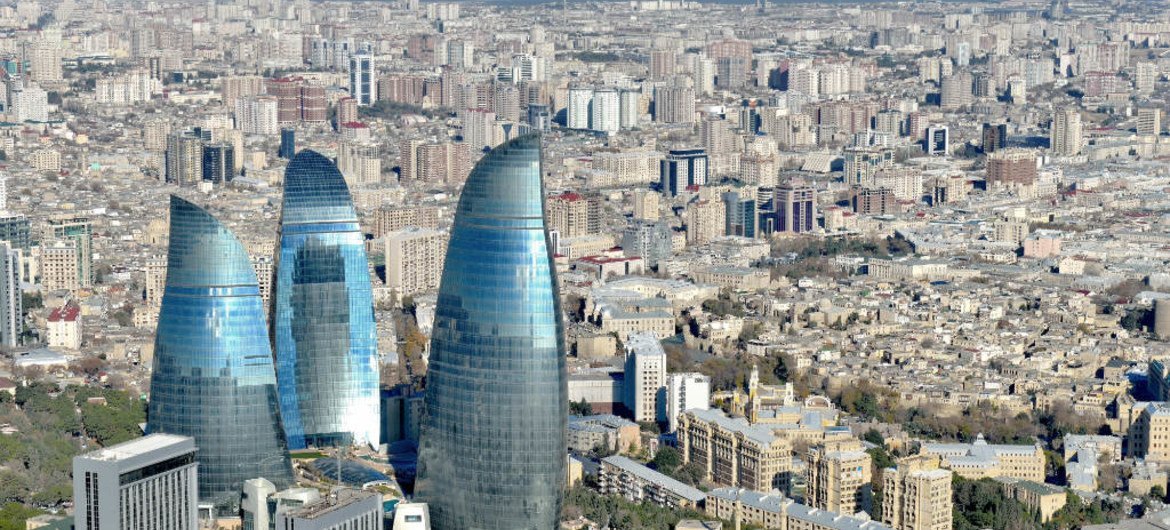
Photo: Ministry of Tourism and Culture, Azerbaijan View of Baku, Azerbaijan
The largest World Urban Forum in history closed in Baku with a sweeping agenda. The hard part was what came next.
Something unusual happened in Baku in May 2026. A United Nations gathering that could easily have produced the customary fog of diplomatic language instead managed to concentrate minds. More than 57,000 participants from 176 countries gathered for the 13th World Urban Forum, the largest in the event’s 24-year history, surpassing even the numbers at the once-a-generation Habitat III conference in Quito a decade earlier. When they departed on May 22nd, they left behind a document that, by the standards of multilateral summitry, had real teeth. The Baku Call to Action, with its 15 recommendations, was the most consequential collective statement on housing in years. Whether it became more than paper depended on choices that no forum could make for national governments.
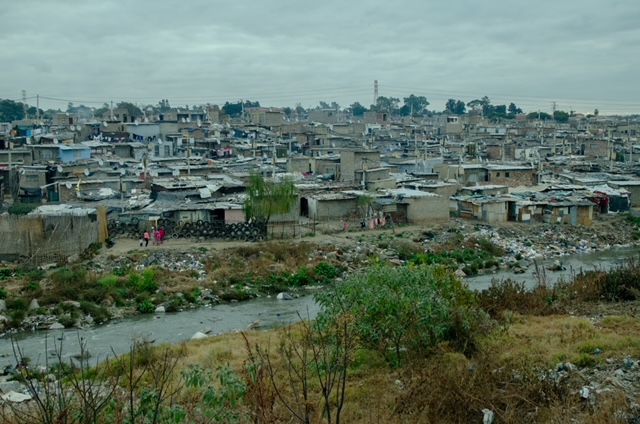
The scale of the problem that brought them to Azerbaijan’s capital was almost impossible to convey without retreating into abstraction. Up to 3.4 billion people worldwide lacked access to secure, safe and adequate housing, including more than one billion living in informal settlements and slums characterised by insecure tenure, overcrowding, exposure to environmental hazards and limited access to basic services. That figure, released alongside the forum in UN-Habitat’s World Cities Report 2026, represented not some fixed floor of deprivation but an accelerating trend. The global housing deficit had grown from 251 million units in 2010 to 288 million in 2023, driven by conflict, climate disruption and the relentless arithmetic of urbanisation outpacing construction. By the end of 2024, 123.2 million people had been forcibly displaced, double the figure of the previous decade.
Not a commodity alone
The forum’s central intellectual contribution, beyond the statistics, was a reframing. For decades, housing policy in much of the world had been left to markets, with governments intervening at the margins through subsidies, zoning rules, or social housing programmes that were invariably underfunded and politically contested. The consensus in Baku was that this approach had failed. UN-Habitat Executive Director Anacláudia Rossbach was unsparing: housing markets were clearly failing to meet people’s needs, and billions were being pushed into inadequate, unsafe and unaffordable living conditions. Her conclusion, repeated throughout the week and echoed in the closing declaration, was simple: housing was a human right.
That declaration carried political weight precisely because it was contested. In many wealthy countries, housing had been treated primarily as an investment asset, a source of household wealth accumulation whose price appreciation was welcomed by incumbents and mourned by aspirants. The Baku Call to Action identified rising urbanisation, mounting financialisation and weak land governance systems as drivers of increasing land costs, property speculation, spatial inequality and insecurity of tenure. The document went further than most international statements in naming financialisation, the conversion of homes into vehicles for capital, as part of the problem rather than part of the solution.
The affordability data made the point with grim clarity. Some 44% of households globally were spending more than 30% of their income on housing, a threshold widely considered the boundary of affordability strain. In Sub-Saharan Africa the figure rose to 55% of renters. Housing prices and rental costs had increased faster than incomes in many parts of the world over the preceding decade, pushing low-income families farther from city centres into peripheral settlements with poor transport links, fewer jobs and limited public services. Young people, migrants and informal workers bore the heaviest share of that burden. In Mumbai and Delhi, house price-to-income ratios had made homeownership functionally unreachable for middle-income families.
The city as political statement
Amina Mohammed, the UN’s Deputy Secretary-General, addressed the closing ceremony on May 22nd with a phrase that captured the forum’s spirit: home is where dignity begins. She argued that adequate shelter was not a standalone good but rather the platform from which all other rights became accessible. Without secure housing, access to clean water, sanitation, energy and education became precarious. Cities, she said, were the architecture of priorities, revealing what societies chose to build and for whom.
Ms Mohammed also struck a sombre note about the broader context in which the forum had met. She warned that there was no pathway to achieving the 2030 Agenda without sustainable urbanisation and adequate housing, and the language she used in the closing session was unusually candid for a senior UN official. The values of the UN Charter were under strain, she said. Tensions were sharper, trust was eroding and geopolitical division was accelerating. The retreat of multilateral commitments, including the dismantling of the United States Agency for International Development and cuts to British overseas development assistance, hung over an agenda that depended heavily on the willingness of wealthy states to support poorer ones.
Yet Ms Mohammed argued that cooperation, especially at the local level, remained not merely the preferred response but the only credible one. Local governments were the ones who answered the phone when a storm hit and who delivered water, transport and housing when it mattered most. The Baku Call to Action called for structural reforms that clarified responsibilities, improved coordination across institutions and empowered local and regional governments through decentralised financing, participatory planning tools and strengthened institutional capacity. The gap between that aspiration and current reality in most developing cities was vast.
The informal city and the limits of formality
One of the forum’s more significant intellectual shifts was its treatment of informal settlements not as aberrations to be cleared but as realities to be upgraded and integrated. The forum reinforced a broader transition in global urban policy thinking that acknowledged informality as part of the contemporary urban condition. The Baku Call to Action urged an approach that was diverse and locally grounded, encompassing incremental housing, city-wide informal settlement upgrading, regularisation, rental and social housing, cooperatives, community land trusts, inclusionary housing and community-led homes.
This mattered because the conventional policy toolkit, designed for formal markets with functioning land registries, mortgage systems and construction industries, simply did not apply to much of the world where the crisis was most acute. In Africa, 62% of urban dwellings were already informal. In the Asia-Pacific region, more than one billion people lived without adequate sanitation. Trying to solve those problems by replicating the institutional machinery of Western housing markets was a category error. The Baku call acknowledged this, though translating the acknowledgement into workable national policies would take considerably more than a declaration.
Finance and governance: the missing links
Across the forum’s 579 events, two themes recurred with the insistence of an unresolved chord: the difficulty of mobilising finance and the weakness of governance. Francine Pickup, head of the UN Development Programme delegation to the forum, highlighted access to financing as a central challenge, particularly for smaller and secondary cities. The problem was structural. Large cities could issue bonds, attract private developers and negotiate with multilateral lenders. Secondary cities, where much of the world’s future urban growth would occur, frequently lacked the institutional capacity, creditworthiness or political connections to access any of those channels.
Participants emphasised that housing affordability, inadequate infrastructure and the expansion of informal settlements represented critical threats to sustainable urban development and economic stability in both developed and emerging economies. Ms Pickup pointed to a project in Punjab, Pakistan, where combining public subsidies, concessional financing and private investment had expanded housing access for low and middle-income families as a model worth replicating. Stefan Priesner, the UN’s Resident Coordinator in India, described that country’s urban transformation as one of the largest-scale and most consequential development journeys of any nation.
The finance gap could not be closed by repurposing existing budgets. Domestic finance across governance levels needed to better target both supply-side subsidies and effective demand-side support to bridge affordability gaps. The forum also highlighted the role of climate finance in that equation. Buildings contributed nearly 37% of global greenhouse gas emissions. Retrofitting existing housing stock in wealthy countries and ensuring that new construction in developing ones was climate-resilient were, simultaneously, climate investments and housing investments. The Baku Call to Action made that link explicit, calling for nature-based solutions, energy-efficient design and the systematic upgrading of settlements vulnerable to floods, heatwaves and sea-level rise.
History and what it asked of the present
The outcomes of the forum and the Baku Call to Action were expected to feed into the High-Level Midterm Review Meeting of the New Urban Agenda, to be held during the United Nations General Assembly in New York in July 2026. That review would measure progress against commitments made a decade earlier in Quito and was likely to find them substantially wanting. Ms Mohammed’s warning had been unambiguous: the next decade of the New Urban Agenda could not look like the last one. More ambition, more financing, more climate action and resilience, and more political urgency were required.
The next World Urban Forum was set for Mexico in 2028, with member states invited to express interest in hosting the 2030 edition. Between May 2026 and then, the test of what Baku produced would be visible not in declarations but in budgets, in zoning laws, in the treatment of informal settlement dwellers by municipal authorities, and in whether international climate finance was structured to reach the communities that needed it most. Forums could set agendas. They could not compel the choices that determined whether those agendas became reality. For the 3.4 billion people whose housing was inadequate, the gap between Baku’s ambition and its eventual impact was not an abstraction. It was the roof over their heads.
Sources
UN-Habitat, World Cities Report 2026: “The Global Housing Crisis: Pathways to Action,” May 2026. WUF, “WUF13 concludes with a powerful call to action on the global housing crisis,” May 22, 2026. UN News, “World Urban Forum backs ‘Baku Call to Action’ on global housing crisis,” May 22, 2026. UN News, “Housing crisis takes centre stage at World Urban Forum in Baku,” May 17, 2026. UN Office at Geneva, “World Urban Forum opens in Baku as housing crisis and climate shocks intensify,” May 17, 2026. ArchDaily, “World Urban Forum 13 Concludes in Baku with Focus on Housing, Resilience, and Urban Inclusion,” May 2026. Parametric Architecture, “WUF13 Baku Concludes With a Global Call for Urban Action,” May 2026. FASI, “Global Housing Crisis: World Urban Forum Backs Baku Call to Action,” May 2026. Down to Earth, “Global Housing Affordability Crisis Deepens, UN Report Warns,” May 2026. Axar.Az, “WUF13 adopts ‘Baku Call to Action’,” May 2026.

Japan Should Not Ignore India’s Authoritarian Turn
Japan should not repeat the mistakes of its China policy. After the Tiananmen massacre of 1989, Japan led the way in re engaging a shunned Chinese government. The West, too, bet on engagement...
From AI To ‘Killer Robots’: UN Chief Issues Urgent Governance Call
Guterres proposed an AI Child Safety Pledge under which developers would have to prove their systems are safe for children, subject to independent oversight; commit to zero tolerance for the...





Our Network
Our Channels

© 2026 Al Jazeera Media Network. All rights reserved.