

Peacekeeping’s Enduring Price
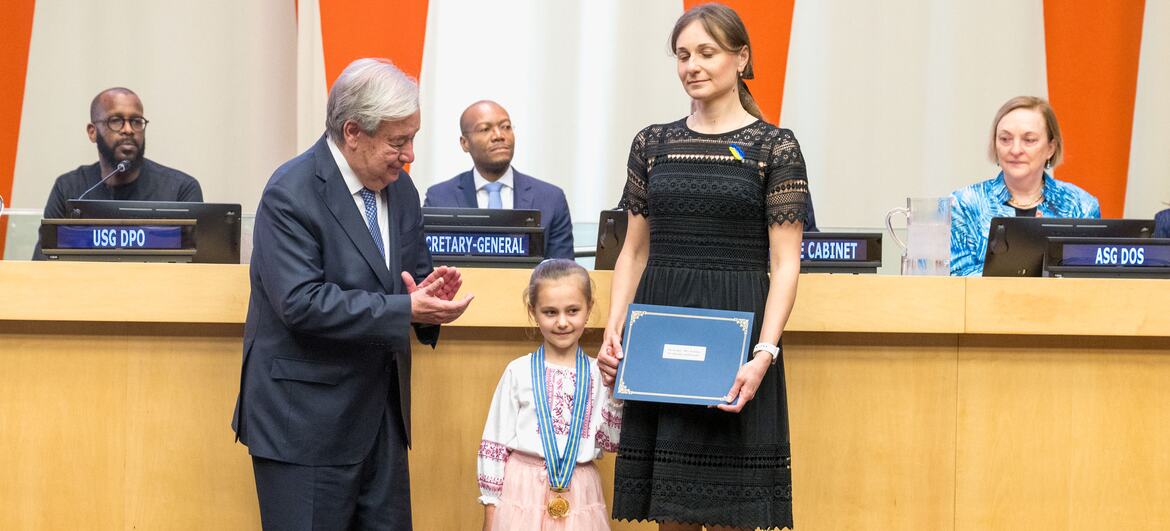
UN Photo/Mark Garten Secretary-General António Guterres presents an award to the family of Sergii Prykhodko, a Ukrainian peacekeeper who was killed in action in South Sudan in March 2025.
The United Nations paused on Friday to honour the more than 4,500 peacekeepers who have lost their lives in the line of duty over the past 78 years. The commemoration was given a grim timeliness: hours before the ceremony, another blue helmet serving with the UN Interim Force in Lebanon died from injuries sustained in a mortar attack, as hostilities between Israeli troops and Hezbollah militants continued.
The day began with Secretary-General António Guterres laying a wreath at the Peacekeepers Memorial at UN headquarters in New York, before presiding over a solemn ceremony attended by senior officials, diplomats, and bereaved families. He posthumously awarded the Dag Hammarskjöld Medal to 68 peacekeepers from 33 nations, including 59 who died in service last year. Their photographs were shown on screen as their names were read aloud. They represent, he said, the best of humanity: people prepared to risk everything to keep others safe.
Two peacekeepers received the Captain Mbaye Diagne Medal for Exceptional Courage, named after a Senegalese officer, killed in Rwanda in 1994. Sergeant Matias Reyes of Uruguay saved lives while serving in the restive eastern DRC in January 2025. The Ebola outbreak there prevented him from travelling to New York to receive the honour. The other recipient, Sergii Prykhodko of Ukraine, a private contractor with a helicopter crew at the UN Mission in South Sudan, sacrificed his life in March 2025 while evacuating besieged soldiers. His widow, Tetiana Prykhodko, who attended with their six-year-old daughter Elizabeth, told those gathered that the medal honours his bravery, but also reminds the world of the true cost of peace: the sacrifices made by those who serve far from home for the sake of people they may never meet.
Speaking to journalists afterwards, she said her husband had always gone where help was needed, knowing danger could be unavoidable. She wanted him remembered not only as a fallen hero, but as a person who chose humanity every single day.
More than 50,000 peacekeepers are currently deployed across the globe, mandated to protect civilians, support elections, deliver humanitarian aid, and clear landmines. The head of UN Peace Operations, Jean-Pierre Lacroix, said that the courage being recognised was not abstract but lived daily in some of the world’s most dangerous environments. Sergeant Milovan Jovanović of Serbia, killed in southern Lebanon on Thursday, was the seventh UNIFIL peacekeeper cut down since hostilities escalated in March. It was his first deployment, and he would have turned 37 on Saturday.
Mr Lacroix highlighted the increasingly complex environments in which peacekeepers operate rising geopolitical tensions, fragmented conflicts, disinformation, evolving technologies, and mounting pressure on multilateral cooperation. Operations also face serious financial constraints arising from delayed and incomplete payment of mandatory contributions, forcing reductions in patrols and air operations, and limiting support to communities. The consequences of inadequate investment in peace, he argued, are measured in lives.
The ceremony also recognised two women peacekeepers. Major Abhilasha Barak of India, serving with UNIFIL, received the Military Gender Advocate of the Year Award. Inspector Stephanie Königs of Germany, who served with the UN Mission in South Sudan, received the 2025 Woman Police Officer of the Year Award.
Friday’s events marked the International Day of UN Peacekeepers, observed annually on May 29th, the date in 1948 when the first UN field mission, the United Nations Truce Supervision Organization, was established in the Middle East. Since then, more than two million women and men have served in 71 peacekeeping missions across four continents.
Sources: UN Photo/Mark Garten; UN News, June 5th, 2026

Japan Should Not Ignore India’s Authoritarian Turn
Japan should not repeat the mistakes of its China policy. After the Tiananmen massacre of 1989, Japan led the way in re engaging a shunned Chinese government. The West, too, bet on engagement...
From AI To ‘Killer Robots’: UN Chief Issues Urgent Governance Call
Guterres proposed an AI Child Safety Pledge under which developers would have to prove their systems are safe for children, subject to independent oversight; commit to zero tolerance for the...




Our Network
Our Channels

© 2026 Al Jazeera Media Network. All rights reserved.