

North Korea’s Forced Labour Reaches Europe
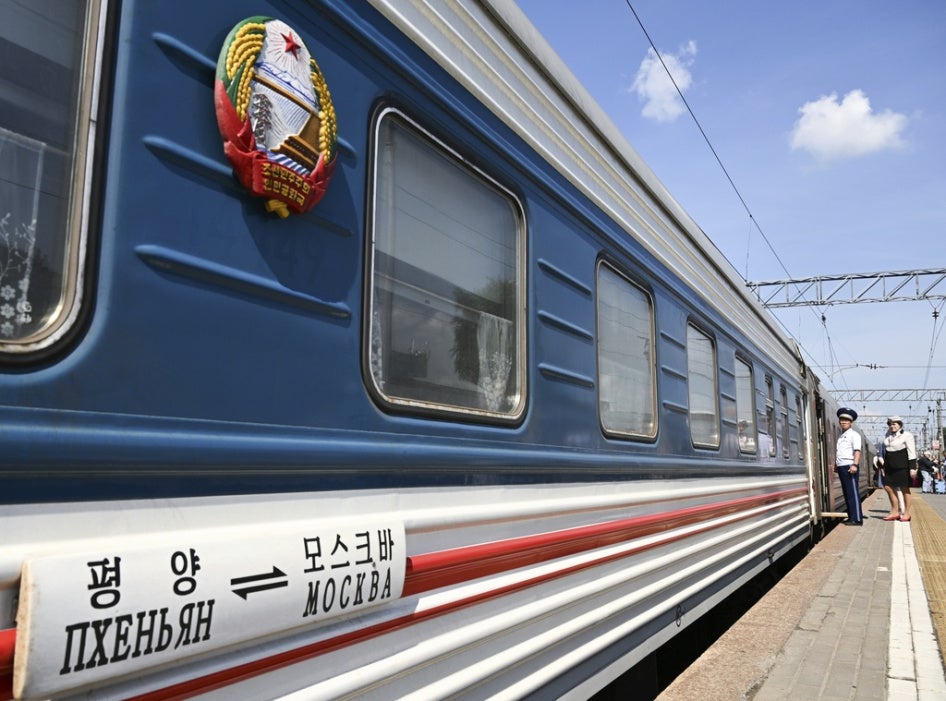
A passenger train from Pyongyang upon arrival at Yaroslavsky Railway Station in Moscow, following the resumption in June 2025 of passenger rail service between the capitals of North Korea and Russia. © 2025 Pelagiya Tikhonova / Sputnik via AP
More than 100,000 North Koreans are estimated to work overseas across 40 countries. Many of them are not there by choice. A new report from Global Rights Compliance, based on interviews with 21 North Korean workers on construction sites in three Russian cities, documents the conditions they face: passports confiscated on arrival, working days of 12 to 16 hours, up to 364 days a year. Wages of around $800 a month are reduced by mandatory quotas remitted to the North Korean government, deductions for travel debts and living costs, leaving workers with as little as $10 a month.
The North Korean state keeps its workers abroad under constant surveillance, embedding informers in the workforce. Speaking out or attempting to escape carries consequences not only for the worker but for family members who remain in North Korea, including loss of employment or housing, forced relocation, interrogation, torture, and enforced disappearance. The overseas labour programme generated an estimated $500m annually for the government in 2024 from non-IT workers alone, with additional revenue from IT workers operating under similar controls.
The consequences reach well beyond Russia. A 2024 investigation by the Outlaw Ocean Project traced North Korean forced labour to Chinese seafood processing plants whose products entered supply chains across the United States, Canada, and Europe. One importer supplied cafeterias in the European Parliament, bringing the products of state-organised forced labour to the heart of EU lawmaking.
The European Commission has a tool to address this: the new EU Forced Labour Regulation, which prohibits products made with forced labour from being sold in the EU market. To be effective, it needs implementation guidelines and a risk database. Human Rights Watch argues that those tools should classify state-imposed forced labour as a distinct category requiring tailored due diligence and should include North Korea’s internal and overseas state-sponsored labour programme explicitly. The objective is not to punish workers but to disrupt the system that exploits them and press the government towards reform. Europe’s supply chains will remain entangled in that system until it does.
Sources: Global Rights Compliance report; Outlaw Ocean Project investigation, 2024; Lina Yoon, Senior Researcher, Asia Division, Human Rights Watch

Japan Should Not Ignore India’s Authoritarian Turn
Japan should not repeat the mistakes of its China policy. After the Tiananmen massacre of 1989, Japan led the way in re engaging a shunned Chinese government. The West, too, bet on engagement...
From AI To ‘Killer Robots’: UN Chief Issues Urgent Governance Call
Guterres proposed an AI Child Safety Pledge under which developers would have to prove their systems are safe for children, subject to independent oversight; commit to zero tolerance for the...





Our Network
Our Channels

© 2026 Al Jazeera Media Network. All rights reserved.