

Forced displacement fell in 2025, but millions remain trapped in perpetual exile
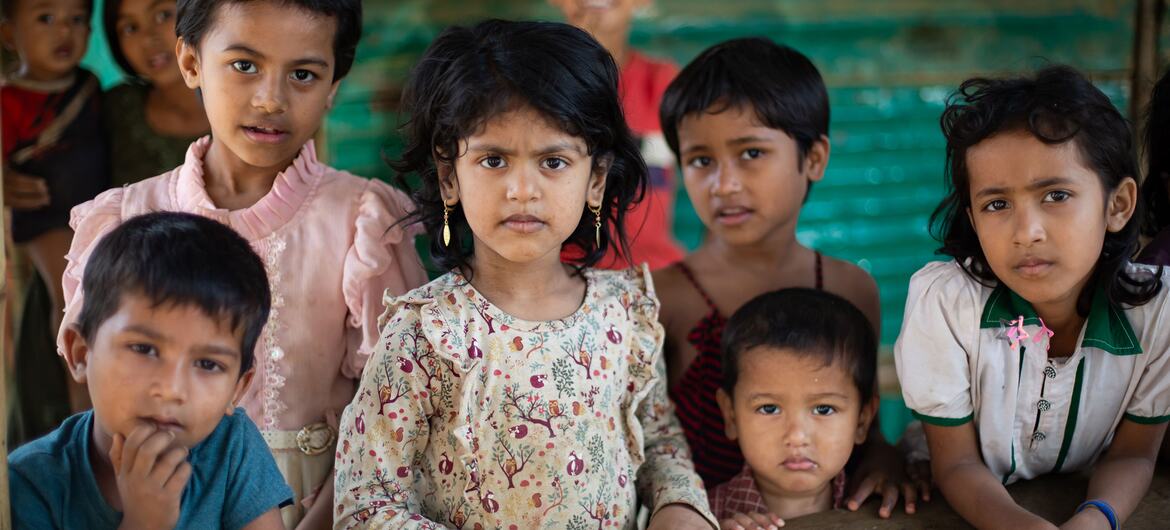
© UNICEF/Royena Rasnat A group of Rohingya refugee children attend an activity centre in Cox's Bazar in Bangladesh.
For the first time in a decade, the number of people forcibly displaced around the world has fallen. According to UNHCR’s Global Trends Report, released in Geneva on June 10th, the total stood at 117.8 million at the end of 2025, down by 5.4 million, or 4 per cent, from the previous year. One in 70 people on earth remains forcibly displaced. The decline, however, offers less cause for celebration than the headline figure suggests.
Returns Under Duress
The fall was driven primarily by a sharp rise in returns. Some 14.7 million displaced people went back to their countries or places of origin during 2025, including 4.4 million refugees and 10.3 million internally displaced persons (IDPs), the second-highest annual figure for refugee returns since UNHCR began keeping records in 1965. Returns to six countries alone accounted for 92 per cent of the total: the Democratic Republic of the Congo (3.6 million), Sudan (3.6 million), Syria (3.3 million), Afghanistan (2 million), Ukraine (718,300) and Myanmar (415,200).
Yet UNHCR was unambiguous in its assessment: most of these returns occurred under duress, to fragile and conflict-affected environments where the conditions for sustainable reintegration remain precarious. Security is absent, basic services are degraded and infrastructure has been destroyed. The agency expressed concern about their long-term viability and the protection risks returnees face.
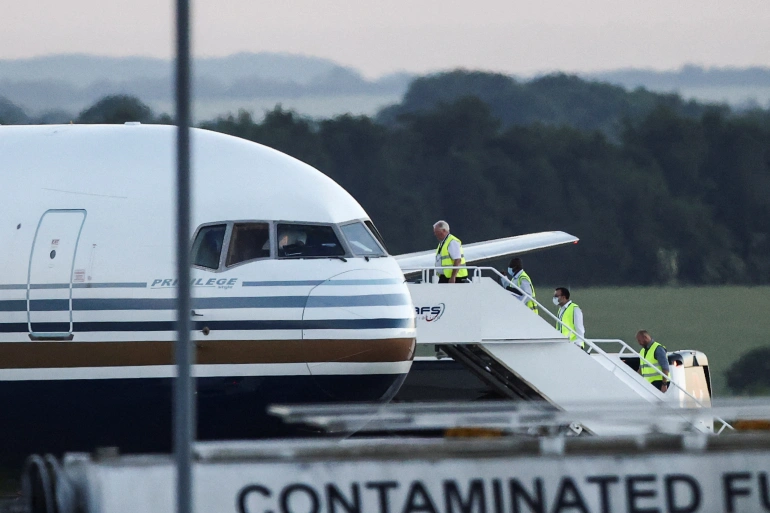
The case of Afghanistan is particularly stark. Approximately 2.9 million Afghans returned during 2025, of whom 1.9 million were refugees, a fivefold increase on the previous year. Most were driven back not by improving conditions at home, but by restrictive government policies in Iran and Pakistan, the two countries that have hosted the bulk of Afghan refugees for more than four decades. In Iran, the expiry of headcount slips held by over 2 million Afghans in March 2025, followed by a government deadline of July 6th for regularisation or deportation, triggered a mass exodus. At peak moments in July, returns exceeded 40,000 people per day. In Pakistan, the resumption of the Illegal Foreigners Repatriation Plan from March 2025 onwards forced out roughly 1 million Afghans, four-fifths of them women and children. Most returnees reported having little or no choice in the matter.
The conditions awaiting them in Afghanistan are grim. The Taliban-controlled country offers limited infrastructure, a collapsed economy and severe restrictions on women’s and girls’ access to education and employment. Fewer than half of female returnees reported the same access to schooling as Afghan children who had never left. More than a third of returnee households could not access medical care.
A Generation in Exile
The profile of global displacement has shifted from an emergency phenomenon to a chronic one. Nearly seven in ten refugees worldwide are in protracted situations, defined by UNHCR as having been in exile for five or more years with no immediate prospect of a durable solution. On a revised definition that removes the previous threshold of 25,000 refugees per situation, there were 24.9 million refugees trapped in just over 1,300 such situations in 2025, compared with 9.2 million in around 500 situations in 2000.
New analysis from UNHCR’s Eastern and Southern Africa region offers a sobering illustration of what protracted displacement actually means in human terms. Among refugees and asylum-seekers registered in the region between 2001 and 2025, the median time spent in asylum was just under 16 years. Children registered before the age of five spend, on average, their entire childhood in the asylum system. Families of five or more remain displaced for nearly 19 years. Women and girls remain in exile for an average of almost 17 years, compared with just over 14 years for men and boys.
These are not emergencies to be managed on short timelines. They are, as UNHCR’s new High Commissioner, Barham Salih, made plain in launching the report, a structural failure of the international system. “For too many refugees, displacement starts as a lifeline but lasts a lifetime,” he said. “We need a paradigm shift that creates a new sense of hope and opportunity for people fleeing war and persecution.”
The 50 by 35 Initiative
To translate that ambition into measurable action, UNHCR has launched what it calls the 50 by 35 initiative, a commitment to halving, by 2035, the number of refugees in low- and middle-income countries who are unable to meet their basic needs without external humanitarian assistance. The benchmark aligns with the UN Sustainable Development Goals and tracks refugees whose consumption, excluding the value of aid, falls below the national poverty line of their host country.
The initiative does not propose withdrawing humanitarian assistance. It proposes systematically expanding the conditions under which refugees can achieve self-reliance: access to labour markets, inclusion in national education and health systems, freedom of movement, civil documentation, and access to social protection. It also seeks to accelerate voluntary repatriation where conditions are genuinely safe, broaden third-country resettlement and sponsorship pathways, and enable local integration where durable alternatives remain elusive.
The urgency of that last point is underscored by the near collapse of resettlement pathways in 2025. Arrivals through resettlement or sponsorship fell by more than half compared to 2024, to just 81,800. The primary cause was the suspension of the United States refugee admissions programme following an executive order signed by President Donald Trump on January 20th, 2025. UNHCR estimates that 2.9 million refugees needed resettlement in 2025. The gap between need and available places has rarely been wider.
Crises Compounding
Even as returns reduced the headline figure, new displacement continued at scale. Eight countries accounted for nearly six in ten of the 5.4 million people who fled across international borders in 2025: Sudan (952,700), Ukraine (788,100), Venezuela (455,300), South Sudan (232,800), Burkina Faso (221,300), Afghanistan (191,400), Mali (177,200) and Myanmar (165,400).
In early 2026, the picture darkened further. Escalating hostilities in Iran and Lebanon since late February generated an estimated 3.2 million temporarily displaced persons in Iran and 1 million IDPs in Lebanon. A fragile ceasefire in Iran, agreed in early April, and a cessation of hostilities in Lebanon in mid-April have not yet allowed mass return. The conflict has also destabilised host countries and triggered a deterioration in protection environments for Afghan and Syrian refugees already living in the region. By mid-May 2026, around 549,800 Syrians and 678,500 Afghans had returned to their countries of origin from several host countries, many reportedly under pressure from the deteriorating security situation in their countries of asylum.
As of end-April 2026, UNHCR estimates that global forced displacement has remained broadly flat at around 117 to 118 million people.
A Structural Challenge
The numbers tell a story that is simultaneously more hopeful and more troubling than previous years. A statistical decline in total displacement, achieved principally through mass returns driven by coercion, does not constitute progress. What it reflects is a world in which the spaces available to those fleeing violence and persecution are narrowing, not broadening, and in which the international responsibility-sharing that underpins the refugee system is fraying.
Salih was direct on this point. “Asylum and protection are lifesaving and not up for debate,” he said. “But we cannot accept a future in which millions of refugees remain trapped for years or decades without realistic prospects of rebuilding their lives.” Achieving the 50 by 35 target, he acknowledged, depends on political will, sustained financing, and a fundamental rethinking of how protection systems are designed from the outset of a crisis, not merely in its aftermath.
More than 70 per cent of refugees originate from just six countries: Afghanistan, South Sudan, Sudan, Syria, Ukraine and Venezuela. The largest hosting countries are Colombia, Germany and Turkey. Nearly 46,000 stateless people acquired citizenship across 24 countries last year, a rare note of progress in an otherwise sobering annual reckoning.
Sources: UNHCR Global Trends 2025 Report, June 10th, 2026; UNHCR Ukraine Population Movements Factsheet 3, May 2026; UNHCR Guidance Note on Afghanistan, Update II, September 2025; UNHCR 2025 Afghan Returns: One Year Recap, February 2026; UNHCR Projected Global Resettlement Needs 2025, June 2024; UNHCR Middle East Situation, Operational Data Portal, accessed May 20th, 2026; The Long Horizon of Displacement in Eastern and Southern Africa, UNHCR, June 2026; UN News, Mali: Secretary-General calls for international solutions to curb spread of violent extremism in the Sahel, April 2026.

Refugees Contribute to Their Host Communities. The World Must Do More to Support Them
This year’s World Refugee Day also marks the 75th anniversary of the 1951 Refugee Convention, adopted in the aftermath of the Second World War. The treaty enshrined the right of anyone...
Refugees: The Resettlement Gap Grows Wider
The shortfall in resettlement places is driven by policy changes in destination countries, including pauses in admissions, more restrictive criteria, and growing backlogs in processing. Low- and...



Our Network
Our Channels

© 2026 Al Jazeera Media Network. All rights reserved.