


Dying in Detention: America’s Immigration Custody Crisis
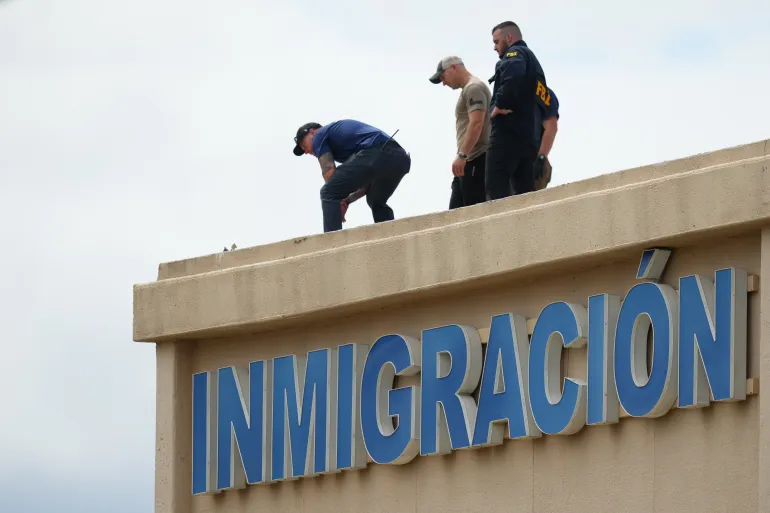
The Trump administration has systematically dismantled the internal oversight mechanisms that existed within the Department of Homeland Security, ICE's parent agency
The death rate in United States immigration detention has surged to its highest level in years. A damning new report finds that inadequate medical care, gutted oversight and near-total opacity are compounding a crisis of the government’s own making.
At least 52 people have died in the custody of United States Immigration and Customs Enforcement since the start of President Donald Trump’s second term, a period of just 500 days. That figure, documented in a 73-page report published on Wednesday by Human Rights Watch and Physicians for Human Rights, reflects a mortality rate that has risen by 140 per cent even as the detained population itself grew by 77 per cent, from around 40,000 to more than 71,000 people. The death toll is not simply a function of scale. People are dying at a faster rate than the expansion of detention alone would predict.
The report, titled “Dying in Detention: Rising Deaths in an Expanding US Immigration Detention System,” draws on quantitative analysis of ICE custody deaths from October 2015 through early June 2026, supplemented by medical analysis of the 39 deaths recorded during the first year of the current administration. In several cases the organisations went further, interviewing family members, attorneys and former cellmates of the deceased and, in two instances, reviewing medical records directly.
The details that emerge from those cases are difficult to read as anything other than institutional failure. Maksym Chernyak, a 44-year-old Ukrainian national, showed unmistakable signs of a medical emergency. Detention staff witnessed his deterioration and failed to act. The resulting delay in transferring him to higher-level care almost certainly contributed to his death. Lorenzo Antonio Batrez Vargas, aged 32, died in 2025 following a Covid-19 diagnosis and twelve days in isolation. His family filed a Freedom of Information Act request in October 2025 and a lawsuit in December. By early May 2026 they had received no additional information. “Only a mother who has lost her child knows what I am feeling,” his mother said. “I want my child, and I can’t do anything.”
These cases are illustrative of a broader transparency failure. ICE is legally required to disclose deaths publicly within 48 hours and to publish more detailed reports within 30 days. The report finds that the agency routinely violates both requirements. The information it does release is so limited that independent analysis of whether the care provided met basic human rights standards is, in most cases, impossible. “ICE so severely limits the information it provides to Congress, families and the public that oversight is nearly impossible,” said Dr Katherine Peeler, co-author of the report, assistant professor of paediatrics at Harvard Medical School and medical adviser at Physicians for Human Rights. “In the cases where we do have access to ICE and outside hospital records, we are seeing a breathtaking breach of the duty of care.”
The opacity is not accidental. The Trump administration has systematically dismantled the internal oversight mechanisms that existed within the Department of Homeland Security, ICE’s parent agency. Whatever accountability structures were in place before January 2025 have been weakened or removed, making it harder for families, lawyers, lawmakers and the public to obtain information, pursue recourse or hold contractors accountable. The result is a detention system that is simultaneously expanding at an unprecedented rate and becoming less visible to external scrutiny.
The legal implications are serious. The deaths of people in immigration detention, and the conditions in which many are held, raise questions of potential violation of the International Covenant on Civil and Political Rights, which obliges states to protect the right to life of those in their custody, and of the Convention Against Torture, which prohibits cruel, inhuman or degrading treatment. The United States is party to both instruments.
Human Rights Watch and Physicians for Human Rights have been documenting abusive conditions in American immigration detention facilities since the 1990s. What is new is the combination of scale, speed and the deliberate removal of the mechanisms that once allowed some degree of accountability. Congress recently appropriated 70 billion dollars for the Department of Homeland Security through 2029. The two organisations argue that without standalone legislative oversight mechanisms, that money risks expanding a system that has demonstrated it cannot protect the lives of those held within it.
Their recommendations are specific. DHS and its contractors should account publicly and promptly for every death in custody. Congress should reduce the detained population, prioritise alternatives to detention and withhold funding for further expansion until conditions are reformed. Independent investigations of every in-custody death should be mandated by law, with autopsy reports and death reviews made public, and penalties imposed on ICE for non-compliance.
The question behind all of this is straightforward, even if the politics surrounding it are not. When a government detains people, it assumes legal and moral responsibility for their lives. When those people die at accelerating rates in conditions that the government refuses to describe, the burden of explanation falls entirely on those in authority. At present, that burden is going unmet.
Sources: Human Rights Watch and Physicians for Human Rights, “Dying in Detention: Rising Deaths in an Expanding US Immigration Detention System,” 25 June 2026; Brian Root, Human Rights Watch; Dr Katherine Peeler, Physicians for Human Rights and Harvard Medical School; ICE custody death data, October 2015 to June 2026; International Covenant on Civil and Political Rights; Convention Against Torture.

Refugees: The Resettlement Gap Grows Wider
The shortfall in resettlement places is driven by policy changes in destination countries, including pauses in admissions, more restrictive criteria, and growing backlogs in processing. Low- and...

From Refugee to Reconciler in The Central African Republic
As a young woman in what she describes as a patriarchal context, she has faced resistance from elders and traditional leaders who question her authority. Rather than seeing her youth as a...









Our Network
Our Channels

© 2026 Al Jazeera Media Network. All rights reserved.