
The History That Must Not Be Questioned: Russia’s War on the Classroom
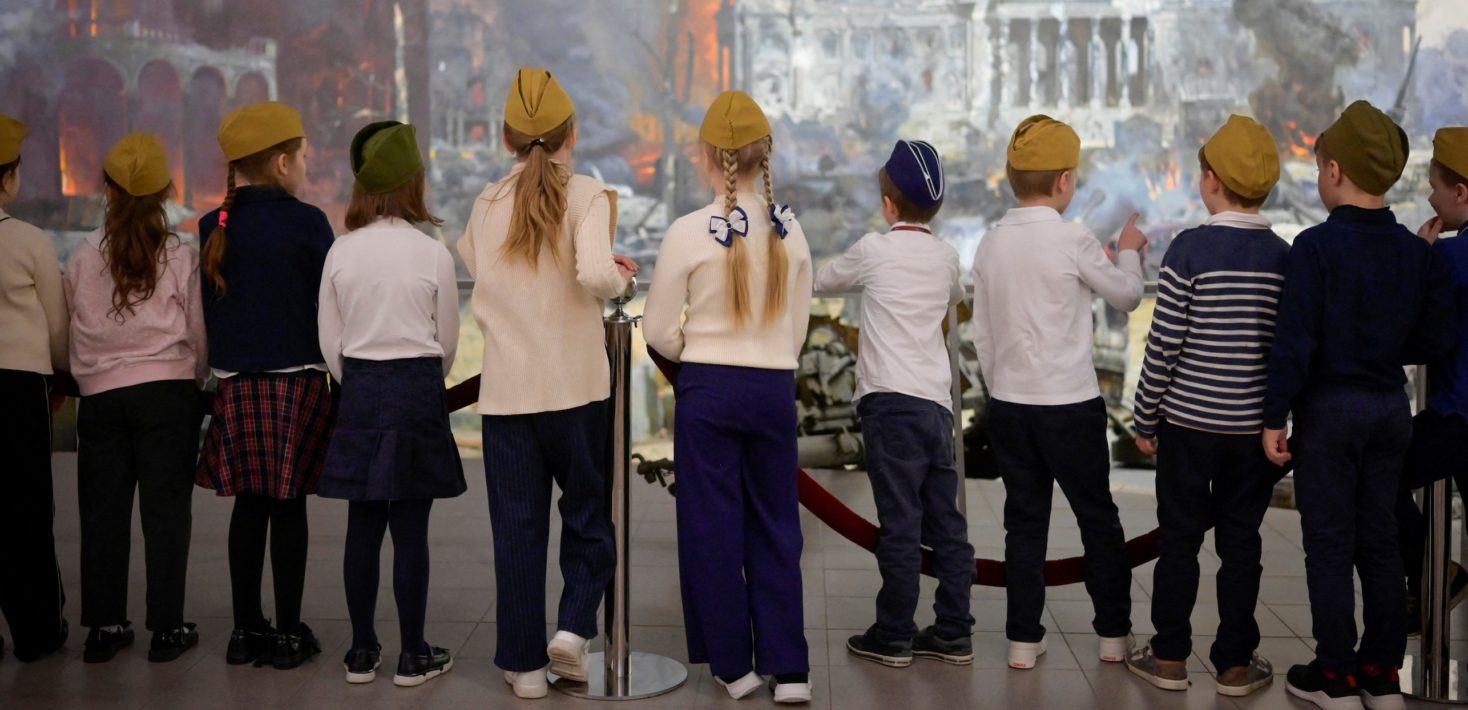
© NATALIA KOLESNIKOVA/AFP via Getty Images
A detailed Amnesty International investigation exposes a state-controlled education system built to produce compliance, not citizens. The architecture of indoctrination is more systematic than most outsiders realise.
There is a passage in Russia’s mandatory history textbook for 11th-graders, studied by 16 and 17-year-olds across the country, that captures the entire enterprise in a single sentence. Discussing the full-scale invasion of Ukraine in February 2022, the book quotes Vladimir Putin: “This is ultimately a question of life and death, the question of our historic future as a people.” What the textbook does not tell its readers is that any sentence contradicting that framing is, under current Russian law, a criminal offence punishable by years in prison. The students learning this history are not being educated. They are being enclosed.
That is the central finding of a detailed new briefing published in June 2026 by Amnesty International, titled “Only Official Sources: Indoctrination in the Russian Educational System.” Based on analysis of legislation, official documents, textbooks, and internal school guidance materials obtained by the organisation, the report maps a system that has been steadily built since 2022 and is still expanding. In early 2026, Ukrainian intelligence reported that Russian authorities had integrated drone operation and firearms training into the formal school curriculum. The ideological and the military have become, for the Kremlin, aspects of the same educational project.
A textbook written by the war’s defenders
The history textbook at the centre of the Amnesty report is not, in itself, new. It was introduced in 2023. What is new is the scale of its deployment and the candour with which its purpose has been stated. Since 2023, history in Russian high schools has been taught from a single, standardised textbook whose lead author is Putin aide Vladimir Medinsky, and whose creators made no secret of the fact that their main goal is to “foster patriotism.” Starting in September 2026, all schools will switch to the same textbook series beginning in fifth grade. The project’s executive secretary, a presidential administration official, told the newspaper Kommersant: “A single, standardised textbook provides the foundation for a shared civic identity. There is no alternative history, just as none of us has, or could have, different parents.”
The man whose name is on the book is a significant figure in his own right. Vladimir Medinsky is simultaneously Putin’s aide, the chairman of the Russian Military Historical Society (which supplies teachers with supplementary propaganda materials), and as of 2025, the head of the Russian delegation at peace talks with Ukraine in Istanbul. His academic credentials have long been disputed: in 2017, a top Russian academic council recommended revoking his doctorate on the grounds that his research was “unscholarly” and ignored “sources if they contradict his theses.” One historian called it a “propaganda pamphlet.” His history textbook for schools has attracted similar descriptions. Historian Nikita Sokolov called it an “outrageously bloated propaganda leaflet.”
The text covers the last 50 years of history with a heavy emphasis on the invasion of Ukraine, replacing statistical data and dates with ideological narratives and extensive quotes from Putin. The Amnesty briefing documents what the textbook does and does not contain. It portrays Russia as a victim of Western conspiracy compelled to invade Ukraine to prevent civilisational catastrophe. It presents the Soviet invasions of Hungary in 1956, Czechoslovakia in 1968 and Afghanistan in 1979 as legitimate responses to Western interference. It justifies the annexation of Estonia, Latvia and Lithuania in 1940 as occurring at the countries’ own request. And it addresses the concept of human rights seven times in more than 440 pages, most of those mentions enclosed in sceptical quotation marks. The Helsinki Accords, the key regional human rights agreement that the USSR signed in 1975, are described as a pretext for interference in Soviet internal affairs. The abolition of press censorship in the late 1980s is presented as a grave mistake that unleashed an “avalanche of destructive and hostile information.”
Updated textbooks are scheduled for release in 2026, including a second edition for grades 5 to 9 and a third edition for upper secondary schools. Despite substantial criticism from teachers, including some who submitted dozens of pages of detailed comments on a single textbook, Medinsky described the repeated rewriting as a “normal process.”
Every Monday, a lesson in correct opinion
Since September 2022, every school week in Russia has begun the same way. A compulsory hour-long session called “Important Conversations” takes place in every grade, in every school across the country. The Ministry of Education publishes teachers’ scripts online, with guiding questions designed to steer students towards preordained conclusions while preserving the outward appearance of dialogue. One script from January 2025 asked: “Why do the warriors of the Special Military Operation deserve to be called defenders of the Fatherland?” The correct answer was provided in the next line, before teachers had asked the question. A script from December 2024 prompted teachers to ask pupils why soldiers in Ukraine inspired the same feelings as Soviet heroes of the second world war, then instructed teachers to tell students that the invasion was conducted to “defend the integrity and sovereignty of Russia, to fight against those who wish to destroy our country.”
One lesson, the Amnesty briefing reveals, was devoted explicitly to the question of where children should seek information. Teachers were instructed to inform pupils that “only official sources of information should be trusted” in order to “form the right opinion, a responsible position on a certain issue.” Children who skip the sessions do not do so without consequence. The briefing documents the case of a ten-year-old girl taken to a police station after her school director filed a complaint about her absence from “Important Conversations.” A child’s WhatsApp profile picture, which was pro-Ukrainian, had been noted. The resulting pressure from the state’s Commission for Juvenile Affairs was sufficient to force her family to leave Russia. From September 2026, similar mandatory classes are to be introduced in kindergartens.
Surveillance in a school uniform
The propaganda component of Russia’s educational system, alarming as it is, may be less structurally novel than its surveillance apparatus. The Amnesty briefing’s most detailed sections document a set of practices known collectively as “profilaktika,” or preventative measures, which instruct teachers to monitor their students, compile files on their opinions, track their social media and report those found to hold dissenting views to law enforcement.
The methodological recommendations, which Amnesty obtained from school websites and official sources, are specific. Teachers are told to conduct “psychological portraiture” of pupils, involving analysis of their beliefs, social media activity, photographs, video shares, subscriptions and even usernames. They are instructed to note “individual radical statements” made during lessons and to maintain a “portfolio” of students’ work to identify those requiring “targeted profilaktika.” They are told to invite guest speakers and use the sessions not merely to persuade students but to identify those who express discomfort with the speakers’ answers, with those students then referred for closer monitoring. The explicit instruction in one set of recommendations: “monitoring must be conducted on an ongoing basis.”
What constitutes a red flag is defined expansively enough to encompass virtually any form of independent thought. The monitored “indicators” include approval of the Ukrainian armed forces, pro-Ukrainian slogans, any content that ridicules official information about the war, references to inflation or falling living standards as consequences of the conflict, and “broadcasting opinions of foreign agents and opinion leaders who follow the pro-Ukrainian and pro-Western agenda.” One document flagged as a risk indicator the use of a particular social media nickname for Vladimir Putin. Another listed “committed to anarchist ideas” as a category requiring surveillance, accompanied by a list of 20 theoreticians of anarchism whose quotation should be treated as grounds for concern.
Teachers are not only watchers. They are also watched. The Amnesty briefing documents how the same monitoring apparatus is directed at school staff. Russian human rights watchdog OVD-Info identified 148 cases of persecution of teachers for opposition to the war between February 2022 and July 2024, including 23 criminal cases and 82 dismissals. About a third of those incidents began with the teacher’s position being reported to the authorities, usually by students, parents or other staff. In the first such known prosecution under Russia’s war censorship laws, an English teacher in Penza was prosecuted after a pupil recorded her mentioning a Russian airstrike on a maternity hospital in Mariupol. She received a five-year suspended sentence.
The legal architecture of total conformity
The surveillance and propaganda are not improvised. They are encoded in law and presidential decree. A November 2022 presidential decree on the “Preservation and Strengthening of Traditional Russian Spiritual and Moral Values” classifies the protection of those values as a national security issue and explicitly tasks security services and the police with implementation. A May 2024 presidential decree on History Education defines the goal of history instruction as strengthening “the community of the Russian world based on traditional Russian spiritual, moral, cultural and historical values,” and frames alternative historical narratives as threats to national security promoted by “the collective West.”
The Russian Constitution, adopted in 1993, nominally prohibits a state ideology and guarantees freedom of expression. In December 2023, the Law on Education was amended to require that education conform to “traditional Russian spiritual-moral values.” The gap between constitutional text and legislative reality is, at this point, absolute.
Amnesty’s briefing situates all of this within Russia’s international human rights obligations, which are unambiguous. The Convention on the Rights of the Child, to which Russia is a state party, requires that education be directed to the development of respect for human rights and preparation of the child for responsible life in a free society, in the spirit of “understanding, peace, tolerance and friendship among all peoples.” The UN Committee on the Rights of the Child, in its 2024 concluding observations on Russia, recommended that the country “put an end to the politicization and militarization of schools.” Russia has not done so. It has accelerated in the opposite direction.
What this produces
The stated logic of the system is straightforward: a generation formed by this curriculum will support the war, distrust Western institutions, identify dissent with treason and understand history as a story of Russian necessity rather than Russian choice. Whether it will succeed in these aims is genuinely uncertain. The current level of propagandistic intensity in Russian textbooks exceeds even the Stalin and Brezhnev eras, according to one comparative analysis, indicating the urgency felt by the Russian state to control the narrative. Intense propaganda does not always produce its intended results; the Soviet system was eventually destabilised by the very generations it formed. But the current Russian system has one advantage its Soviet predecessor lacked: the technology to monitor, in near-real time, what young people are actually thinking.
The Amnesty briefing does not predict what Russian children will believe when they grow up. It documents, with considerable precision, what they are being taught and what happens to those who resist. It is a record of a state that has decided, with great deliberation and at great institutional expense, that a child’s mind is its property. That decision, and the system built to enforce it, will have consequences that outlast the war that prompted them.
Sources
Amnesty International, “Only Official Sources: Indoctrination in the Russian Educational System” (EUR 46/0956/2026), June 2026
Meduza, “How Russia’s School History Lessons Are Reframing Stalin, Gorbachev, and the War in Ukraine,” March 2026
United24 Media, “Russia to Rewrite School History Textbooks Again After Teachers Flag Errors and Propaganda,” February 2026
United24 Media, “Russia Turns War Into School Curriculum as Students Forced to Learn Dead Soldiers’ Names,” March 2026
The Moscow Times, “Russia to Introduce Standardized School Textbooks Promoting ‘Patriotism’ and ‘Traditional Values’,” October 2025
Wilson Center, “Russian Schools in a Time of War: A Lesson in Indoctrination”
Radio Free Europe / Radio Liberty, “Books to Boots: Critics Say New Russian History Textbook Is Propaganda, Preparation for War,” August 2023
UA Crisis, “Distorted Narratives: Russian Propaganda and Historical Manipulation in Education,” August 2023
OVD-Info, “Either a State Opinion or No Opinion: How Teachers Are Persecuted for Anti-War Stances,” September 2024
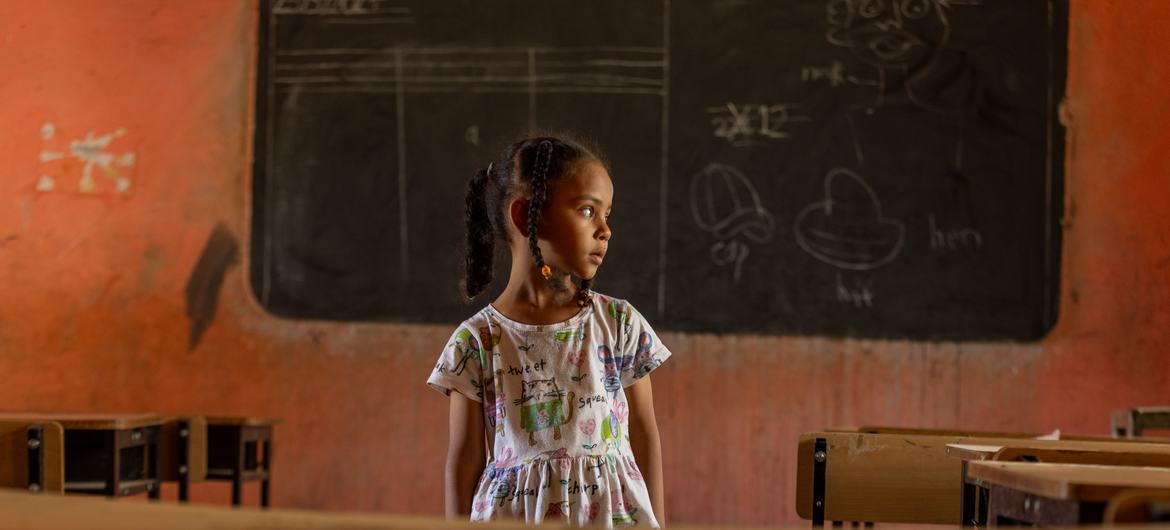
Left Behind: The Global Education Crisis
Progress since 2015 has slowed across nearly every region, with sub-Saharan Africa especially hard hit. In conflict zones, official figures almost certainly undercount the true scale of...
Sudan Schooling Under Siege
Remote learning has been largely infeasible for most Sudanese children owing to infrastructure collapse and displacement, deepening a generational learning deficit with long-term humanitarian...

Our Network
Our Channels

© 2026 Al Jazeera Media Network. All rights reserved.