

The Doctor Who Would Not Stop Being a Doctor…
Dr Ahmad Mhanna, the hospital's director, was handcuffed, blindfolded and led away in his surgical scrubs to a nearby building, where he was left restrained on a stairwell overnight/Amnesty.
Twenty-two months in Israeli detention, including beatings, engineered hunger and two deaths witnessed at close range: a Gaza physician tells his story.
At around four in the afternoon on 16 December 2023, Israeli soldiers raided Al-Awda Hospital in the Jabalia refugee camp in northern Gaza. Dr Ahmad Mhanna, the hospital’s director, was handcuffed, blindfolded and led away in his surgical scrubs to a nearby building, where he was left restrained on a stairwell overnight. No one questioned him. In the small hours, a bulldozer began working close enough to shake the walls. He feared the building would collapse before the machine finally moved on.
By morning, the restraints were removed. A soldier ordered him back to the hospital with a warning: “If you refuse to cooperate, the gun will speak.” What followed was a forced roll call of every male in the facility aged between 16 and 60, ordered to strip to their underwear in the cold. Among those arrested was a patient with an amputated leg. Then a soldier told Dr Mhanna that colleagues in Tel Aviv wanted to “have a drink” with him. He understood immediately that he was being taken indefinitely.
Into the system
The journey through Israel’s detention infrastructure was methodical and brutal. At the first facility, detainees were placed in what guards called the “disco room”: bare stone floors, a ventilator blasting cold air and extremely loud music played continuously for 24 hours to prevent sleep. Interrogators accused Dr Mhanna of providing medical treatment to fighters. When his answers did not satisfy them, they beat him and threatened to break his bones.
He was then moved to Sde Teiman, an Israeli military base that also functions as a detention centre, where an interrogator threatened to harm his wife and daughters. Over 24 days he never appeared before a judge. A subsequent transfer brought him to what detainees called Al-Kallaba, the dog kennel, where handcuffs were never removed and guards released dogs on the prisoners. He remembers the weight of a dog lying across his back.
Transfer to the Negev detention centre brought the tashrifa, a reception ritual of beatings and humiliation in which boiling water was thrown on the arriving detainees. He would remain in that tented facility for over a year, most detainees sleeping on the floor.
Engineered deprivation
The first time Dr Mhanna appeared before a judge was three months into his detention, via a brief video call on a laptop. He was told he was being held on secret evidence under Israel’s Unlawful Combatants Law. In one hearing he was accused of affiliation with Hamas: in the next, with the Popular Front for the Liberation of Palestine. “My only real crime,” he writes, “was being a doctor.”
Food was scarce, dirty, and sometimes contaminated with cigarette ash. If guards discovered that detainees had saved scraps, the entire cell was punished. There was no soap, no toothbrush, and no access to showers for six months, conditions that produced widespread scabies. Clothing could not be changed during that period. Two detainees died in front of him. One died of ascites. Dr Mhanna pleaded with guards for antibiotics, telling them the man could be saved. The response: “You are not a doctor here; you are a terrorist.”
A lawyer reached him seven months after his arrest. Until that visit, his family did not know whether he was alive. Learning that his wife Alaa had spent months searching for him, he later wrote, was the first time he felt human again.
Release and aftermath
On 11 October 2025, a representative of the International Committee of the Red Cross visited and told him he was on a list of detainees to be released. The ICRC mentioned providing a “dignity kit.” After months of treatment he describes as designed to strip prisoners of their humanity, the word dignity, he wrote, was overwhelming to hear.
He was released on a Monday and arrived at Nasser Hospital at six in the evening, where colleagues welcomed him back. He had lost 28 kilogrammes. He learned that Al-Awda Hospital had been severely damaged and remains inaccessible behind the Israeli military’s designated boundary line. Insomnia, anxiety, and trauma continue.
He intends to keep working. Amnesty International, which published his testimony as part of its ongoing documentation of detention conditions in Gaza, has called for the immediate and unconditional release of all those it considers arbitrarily detained, and continues to document what it describes as Israel’s systematic use of torture and ill-treatment against Palestinian detainees. Israel disputes that characterisation.
“I was a doctor when they took me,” Dr Mhanna writes, “and I am a doctor now that I have returned. My commitment to my patients remains the one thing they could not take away.”
Sources: Amnesty International; testimony of Dr Ahmad Mhanna, former director of Al-Awda Hospital, Jabalia, northern Gaza; 21 May 2026.
The Deaths No One Sees
Ceasefires may halt shelling, but they rarely touch what happens behind locked doors. In this conflict, the hidden costs are only just surfacing.
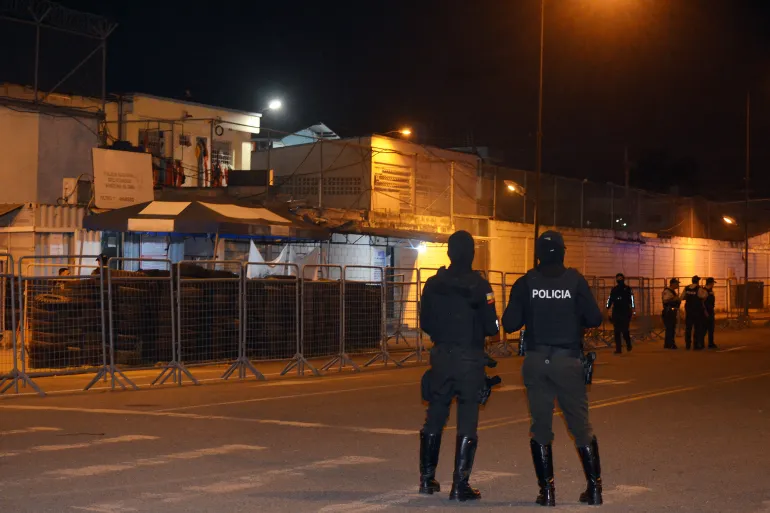
Drug-Trafficking Riots & Killings in Ecuador’s Prisons
For years, Ecuador’s prisons have doubled as nerve centres for drug-trafficking groups battling for control of a trade that stretches from the Andes to the Pacific. More than 500 inmates have...

- Most Viewed
- Most Popular




Our Network
Our Channels

© 2026 Al Jazeera Media Network. All rights reserved.