
In Yemen, the War’s Cost Falls Hardest on Women
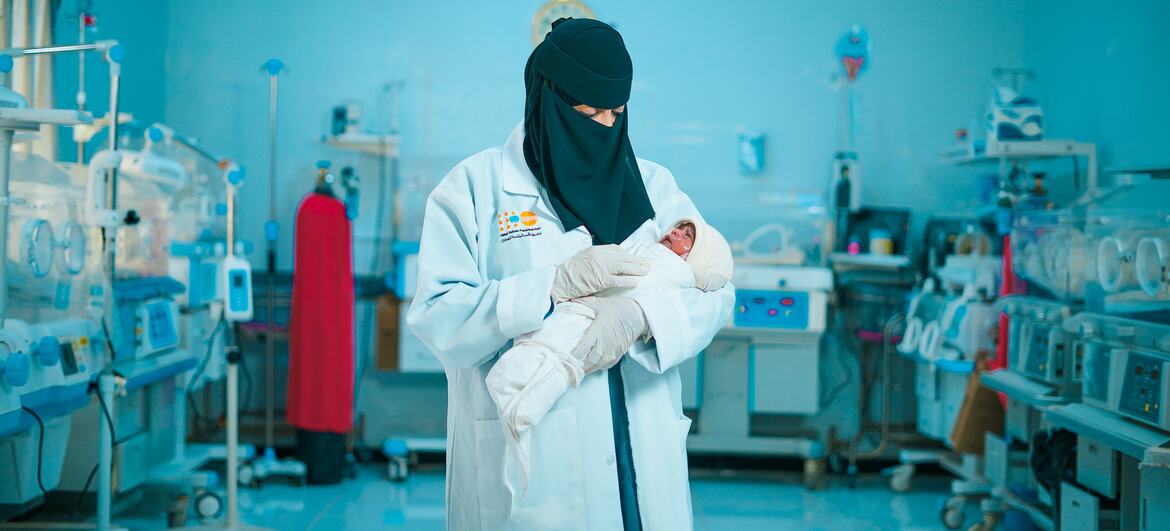
© UNFPA Yemen A midwife at a maternity ward at a UNFPA-supported hospital in Marib, Yemen, carries a baby who was about to die along with his mother who had a difficult labor and arrived at the hospital just in time.
Of the 35m people in Yemen, 22m now need humanitarian help, and half of them are women and girls, two thirds of childbearing age. That arithmetic places reproductive health at the Centre of what aid workers increasingly call a forgotten crisis.
Francesco Galtieri, the UN Population Fund’s (UNFPA) senior official in Yemen, points to rising malnutrition as the most immediate threat, particularly for pregnant women, whose poor nutrition damages both their own health and that of their babies. Healthcare access compounds the problem: Yemen has the highest maternal mortality rate in the Arab region, with three women dying daily from pregnancy related causes, roughly two thirds of which could be prevented with access to a midwife or doctor.
Beyond health, conflict and economic collapse have sharpened the risks of gender-based violence. UNFPA runs safe spaces offering psychosocial support, vocational training, and legal assistance to survivors, alongside efforts to help women rebuild livelihoods.
The trouble is money. Galtieri says roughly 40% of UNFPA’s humanitarian funding in Yemen was cut last year, forcing the suspension of about a third of its services. Shelters for survivors of gender-based violence have this year been unable to take in new arrivals. In a country where maternal mortality is already among the world’s worst, fewer midwives and clinics translate directly into more dead mothers and babies.
M Galtieri is currently in New York for UNFPA’s Executive Board meetings, where he says debate over sexual and reproductive health rights has reached an intensity unseen in decades. He puts the question bluntly: why, when societies enter periods of tension, do women and girls so often become the focus of political confrontation? His appeal to donors is equally blunt: midwifery and lifesaving care should not be controversial budget lines, whatever else competes for funding.
Sources: UN News, 12 June 2026.
- Most Viewed
- Most Popular



Our Network
Our Channels

© 2026 Al Jazeera Media Network. All rights reserved.