

Saving Lives Is Not a Crime

Archive/Al Jazeera.
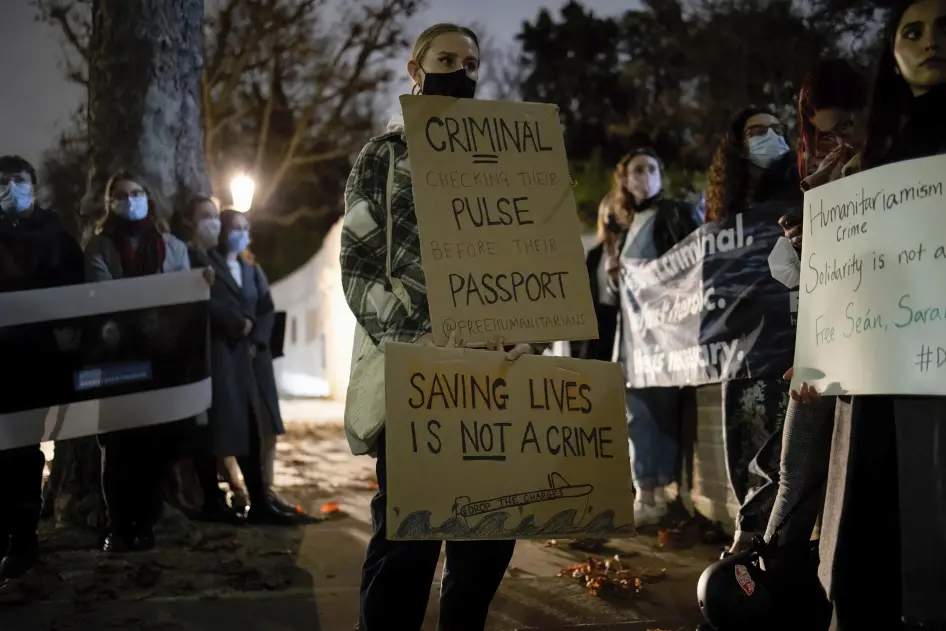
On 15 January 2026, Sean Binder was acquitted after nearly eight years of legal ordeal that began with an arrest by Greek police at approximately 2am on a February morning in 2018. Binder had been working with the Emergency Response Center International, conducting search and rescue operations for people fleeing conflict and arriving in Europe on unseaworthy vessels. His acquittal, and that of his 23 co-defendants, was unanimous: the panel of judges agreed with the prosecutor that there was no evidence of criminality, and that Binder and his colleagues had been motivated by, and engaged in, legal humanitarian work.
What Binder experienced was not an aberration but an exemplar of a systematic pattern. After his initial arrest in February 2018, Binder was released pending investigation and continued working alongside the very authorities who had detained him. Six months later, he was arrested again, this time on charges of staggering seriousness: forgery, illegal use of radio frequencies, espionage, money laundering, membership of a criminal organisation and facilitation of illegal entry. He spent 106 days in pre-trial detention before release. By then, his case had become a symbol of what human rights organisations called the ‘criminalisation of saving lives.’
The damage done in the years between arrest and acquittal has been real and irreversible. More than 32,000 people have died at Europe’s borders since 2014. Dozens of other humanitarians across Europe continue to face similar prosecutions, obstructions, intimidation, and harassment. Binder’s acquittal, while welcome, does not make those lives and those prosecutions retroactively justified. ‘My colleagues and I have spent years and vast resources proving what should never have been in doubt,’ he writes. ‘Saving lives is a legal obligation, not a crime.’
The current effort to reform EU anti-smuggling legislation, the so-called Facilitators Package, offers a legislative opportunity to address the structural problem. However, the proposed revisions contain elements that, as Amnesty International has warned, risk perpetuating the criminalisation of refugees, migrants, and human rights defenders rather than ending it. The proposal introduces a new crime of ‘public instigation’ of irregular migration, a vague provision that could, in the wrong hands, be used against advocates, activists and legal professionals aiding.
Any credible reform must explicitly and in binding terms exempt acts of humanitarian assistance and solidarity from criminal prosecution, protect migrants who may themselves have been smuggled from liability, and shield family members assisting relatives. It must align with the EU Charter of Fundamental Rights, UN Conventions and Smuggling Protocols, and the international legal duty to render assistance at sea. The European Court of Human Rights found serious evidence of systematic pushbacks in Greece in 2025, and evidence of similar practices is mounting across European borders. These are the real crimes the Facilitators Package should target.
Binder’s conclusion is as practical as it is moral: ‘The way to stop people taking dangerous journeys is providing safe and legal pathways for protection, commensurate in scale with the need for protection, and channels for regular migration for those seeking a better life.’ Denying safe routes does not eliminate the movement of desperate people; it redirects them into the arms of smugglers and traffickers, while criminalising those who try to help them survive the crossing. Europe cannot credibly claim to respect human rights while prosecuting those who practice them.
(Sources: Sean Binder testimony, January-March 2026; Amnesty International Facilitators Package analysis; European Court of Human Rights ruling, 2025; IOM Missing Migrants Project)

U.S. Immigration Policies Harm Pregnant Migrants
ICE’s official policy states that pregnant, postpartum, or nursing women are generally not to be detained for administrative immigration violations unless legally required or under exceptional...
Impunity in Uniform/Israel’s Decision to Drop Charges Against Soldiers at Sde Teiman Is a Disgrace
The decision came at a moment of rising regional tensions and intense international scrutiny of Israel’s conduct in Gaza. That it was welcomed publicly by the prime minister, rather than...


- Most Viewed
- Most Popular







Our Network
Our Channels

© 2026 Al Jazeera Media Network. All rights reserved.